



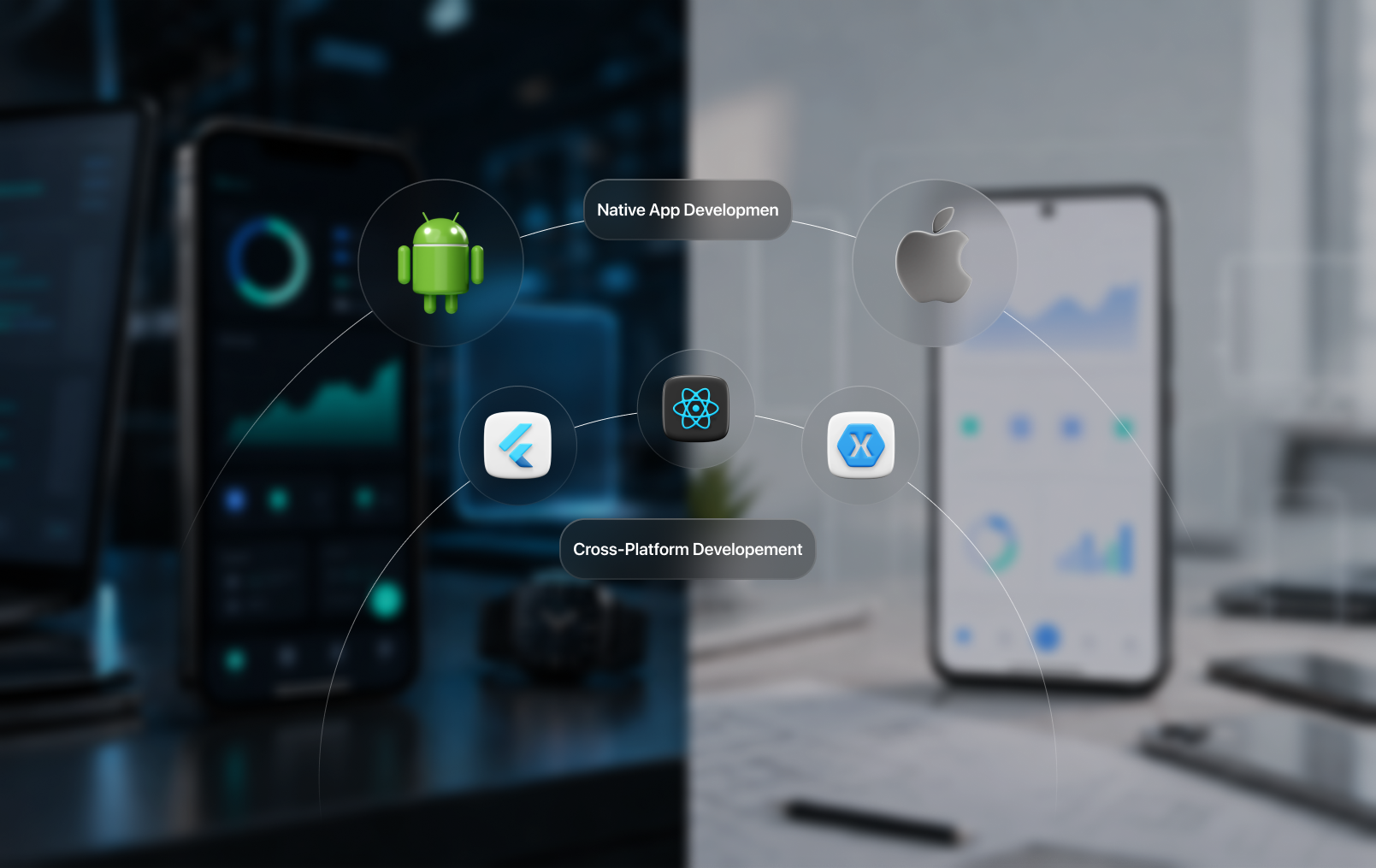
Mobile app development has never offered more choices. Flutter, React Native, Kotlin Multiplatform, SwiftUI, and Jetpack Compose have all matured into capable technologies, making it easier than ever to build apps for both iOS and Android. Yet this progress has created a bigger challenge for founders, product managers, and CTOs: Should you invest in native app development or choose a cross-platform approach? The answer can significantly affect your product's performance, development costs, scalability, user experience, and long-term return on investment.
Many businesses focus on reducing upfront development costs, but that's only one part of the decision. The architecture you choose today will influence future maintenance, feature expansion, AI integration, security, and engineering flexibility for years to come. In this guide, we'll compare native vs. cross-platform app development from a business perspective, explain where each approach delivers the greatest value, and help you choose the right strategy before partnering with a mobile application development company.
Why Does This Decision Matter More Than Ever in 2026?
Choosing between native and cross-platform development is no longer just a technical decision; it directly impacts product performance, customer experience, scalability, security, and long-term ROI. As mobile applications become the primary channel for digital commerce, subscriptions, financial services, and AI-powered experiences, selecting the right architecture early can reduce technical debt and support sustainable business growth.
Mobile Apps Have Become Revenue Engines
Mobile applications now drive customer engagement, subscriptions, and digital transactions across industries. According to Statista, the global mobile app market is expected to exceed US$781 billion by 2029, making app performance and user retention key business priorities rather than technical considerations.
Users Expect a Premium Experience
Modern users expect fast launch times, smooth navigation, biometric authentication, offline access, real-time notifications, and AI-powered personalization as standard features. Poor performance often leads to lower app ratings, reduced retention, and lost revenue, making user experience a competitive advantage.
AI Is Increasing Hardware Demands
Features such as on-device AI, real-time translation, computer vision, recommendation engines, and voice assistants require efficient access to platform hardware. Native applications typically adopt new capabilities like Apple Intelligence, Core ML, ML Kit, and Gemini-powered APIs more quickly because they use the official iOS and Android SDKs.
Performance Impacts Business Growth
Performance is no longer just an engineering metric; it also influences customer satisfaction, engagement, conversions, and subscription retention. This is especially important for FinTech, healthcare, OTT streaming, logistics, gaming, and eCommerce applications, where responsiveness directly affects business outcomes.
Architecture Determines Long-Term ROI
While Flutter and React Native remain excellent choices for MVPs and many business applications, native development often provides greater flexibility for products requiring enterprise security, advanced hardware integration, AI capabilities, and long-term scalability. The most successful businesses evaluate architecture based on total cost of ownership (TCO) and future product growth—not just the initial development budget.
Is Native App Development Always the Best Choice?
Not necessarily. Choosing native development should be based on your business goals rather than assuming it is the superior option in every situation.
If your priority is validating an MVP quickly, launching with a limited budget, or building a relatively simple business application, cross-platform frameworks like Flutter or React Native can significantly reduce development time while delivering an excellent user experience.
However, if your application depends on high performance, enterprise-grade security, advanced hardware integration, AI-powered features, or long-term scalability, the additional investment in native development often delivers stronger returns over the product's lifecycle.
The most successful businesses evaluate this decision by balancing performance requirements, total cost of ownership (TCO), expected product growth, maintenance complexity, and user experience rather than focusing only on the initial development cost.
What Is Native App Development?
Native app development is the process of building mobile applications specifically for a single operating system using its official programming language and Software Development Kit (SDK). iOS apps are typically developed with Swift and SwiftUI, while Android apps use Kotlin and Jetpack Compose. This approach allows developers to deliver the highest level of performance, security, and integration with platform-specific features.
How Does Native App Development Work?
Unlike cross-platform frameworks that share one codebase across multiple platforms, native development creates a dedicated application for each operating system. Each app is built using the tools officially provided by Appleand Google, enabling direct communication with the operating system without relying on additional abstraction layers.
Because native apps interact directly with platform APIs, developers have immediate access to the latest operating system capabilities as soon as they are released. This is especially valuable for businesses that want to adopt new features without waiting for third-party framework support.
Why Do Businesses Choose Native App Development?
The biggest advantage of native development is complete access to device hardware and operating system features. This allows developers to build applications that feel faster, more responsive, and more reliable across different devices.
Native applications can efficiently integrate with features such as the camera, GPS, Bluetooth, NFC, biometric authentication (Face ID and fingerprint recognition), background processing, push notifications, and advanced graphics processing through platform-specific APIs. As new hardware capabilities are introduced, native apps can typically support them immediately using the official SDKs from Apple or Google.
For businesses building fintech platforms, healthcare applications, OTT streaming services, logistics solutions, or AI-powered products, this level of integration can improve both the user experience and long-term product flexibility.
Does Native Development Offer Better Performance?
Performance differences are often misunderstood. The issue is rarely raw CPU speed.
Native interfaces are rendered directly using UIKit on iOS and Jetpack Compose or Android Views on Android. Flutter, by comparison, draws its interface using the Skia graphics engine, which gives developers a consistent UI across platforms but introduces an additional rendering layer.
For most CRUD-style business applications, users are unlikely to notice this difference.
However, workloads involving simultaneous camera previews, multiple live video streams, advanced animations, interactive maps, augmented reality, or machine-learning inference place significantly greater pressure on rendering pipelines, memory management, and GPU resources. In these situations, native applications generally maintain higher frame rates, lower latency, and better battery efficiency because they interact directly with platform rendering APIs.
This is why video streaming platforms, gaming applications, navigation systems, and AI-powered mobile products often prioritize native development despite higher initial costs.
Native vs Cross-Platform Apps: What's the Difference?
Native vs cross-platform app development solves the same problem, building mobile applications, but they follow different engineering approaches. Native apps are built separately for iOS and Android using each platform's official tools, while cross-platform frameworks reuse a single codebase across multiple platforms. The better choice depends on your business goals. The comparison below highlights the practical differences that matter most to business decision-makers.
Rather than asking "Which technology is better?", ask "Which technology best supports my business objectives, customer expectations, and product roadmap?" Answering that question will almost always lead to a better long-term decision than comparing development costs alone.
When Should You Choose Native App Development?
Native app development delivers the greatest value when performance, security, scalability, and user experience directly impact business success. If your application is expected to grow into a long-term digital product, the additional upfront investment can reduce technical debt and improve long-term ROI.
1. Performance Directly Impacts Revenue
Choose native development when app responsiveness influences customer retention, conversions, or revenue. Native apps communicate directly with the operating system, delivering smoother animations, faster startup times, lower latency, and better battery efficiency. This is especially important for OTT platforms, FinTech apps, gaming, ride-hailing, and real-time communication applications.
2. Your App Relies on Device Hardware
Native development is the better choice if your product depends on GPS, BLE, NFC, biometrics, advanced camera APIs, AR, or other platform-specific features. Direct access to iOS and Android SDKs enables faster adoption of new hardware capabilities while reducing reliance on third-party plugins.
3. Security and Compliance Are Critical
Industries such as banking, healthcare, insurance, and enterprise software require stronger security control over encryption, secure storage, certificate pinning, and biometric authentication. Native development makes it easier to implement platform security features and comply with standards like GDPR, HIPAA, and PCI DSS.
4. You're Building a Long-Term Product
If your roadmap includes AI, offline functionality, wearables, Smart TV apps, or continuous feature expansion, native development provides greater architectural flexibility. While the initial investment is higher, it often reduces technical debt and lowers the total cost of ownership (TCO) as the product scales.
5. User Experience Is Your Competitive Advantage
When customer experience is a key differentiator, native development offers the most polished experience by following Apple's Human Interface Guidelines and Google's Material Design. This helps create faster, more intuitive interactions that improve app ratings, engagement, and long-term retention.
6. AI and Real-Time Processing Are Core Features
Applications using on-device AI, computer vision, live streaming, image processing, voice assistants, or real-time communication benefit from native development. Native apps integrate directly with frameworks such as Core ML, ML Kit, and Apple Intelligence, providing better access to CPU, GPU, and Neural Processing Unit (NPU) resources for lower latency and improved performance.
Which Industries Benefit Most from Native Development?
Simply saying "Healthcare should use native" isn't particularly helpful. The real question is why certain industries repeatedly choose native development despite higher costs.
Healthcare
Healthcare applications often integrate Bluetooth Low Energy (BLE) medical devices, HealthKit, Health Connect, offline patient records, secure biometric authentication, background synchronization, and barcode or document scanning. These capabilities require stable access to platform APIs, making native development the preferred option for many regulated healthcare products.
FinTech
Financial applications prioritize biometric authentication, hardware-backed encryption, NFC payments, fraud detection, certificate pinning, and secure key storage. Native SDKs generally expose these platform security capabilities first, allowing faster adoption of new security features.
OTT & Video Streaming
Streaming platforms rely heavily on DRM technologies such as Widevine, FairPlay, adaptive bitrate streaming, offline downloads, Chromecast, AirPlay, Smart TV integrations, and advanced video playback optimization. Native SDKs typically provide greater flexibility for implementing these capabilities.
Logistics
Fleet management and delivery applications often require continuous GPS tracking, background location updates, barcode scanning, offline maps, route optimization, and battery-efficient background processing. Native applications provide greater control over these hardware-intensive workflows.
Lessons We've Learned (Icode49 Technolabs) After Building Native and Cross-Platform Applications
1. Frameworks Rarely Cause Project Failure. Poor Architecture Does
One of the biggest misconceptions is that choosing Flutter, React Native, or native development determines whether a project succeeds. In reality, most projects struggle because business requirements evolve faster than the application's architecture can support. A well-designed Flutter application can scale successfully, while a poorly planned native application can still accumulate significant technical debt. The technology is only one part of the equation; the overall architecture has a much greater impact on long-term success.
2. Cross-Platform Works Extremely Well for Standard Business Applications
For many business applications, users cannot distinguish between a well-built Flutter app and a native app. Products such as CRM systems, booking platforms, eCommerce apps, marketplaces, SaaS applications, and internal enterprise tools primarily display forms, dashboards, API-driven content, and standard UI components. In these scenarios, Flutter and React Native deliver excellent performance while reducing development time and maintenance costs through a shared codebase.
3. Native Becomes More Valuable as Hardware Dependency Increases
The biggest architectural shift occurs when an application relies heavily on device hardware or real-time processing. Features such as continuous GPS tracking, live video streaming, computer vision, Bluetooth Low Energy (BLE), NFC, augmented reality, DRM-protected media playback, and on-device AI inference require deeper operating system integration. As these capabilities become central to the product, native development often provides greater stability, lower latency, and faster access to new platform APIs.
4. Plugin Maintenance Is Often the Real Engineering Challenge
In our experience, Flutter itself is rarely the bottleneck. The larger challenge is maintaining third-party plugins. Every major iOS and Android release introduces new APIs and platform changes, but community plugins may take weeks—or sometimes months—to support them. Enterprise engineering teams frequently solve this by building custom native bridges for critical features while continuing to use Flutter for the majority of the application's interface. This approach reduces dependency on external plugin updates without abandoning the shared codebase.
5. Most Enterprise Applications Eventually Adopt a Hybrid Architecture
A common assumption is that successful products are either fully native or fully cross-platform. In practice, many mature applications combine both approaches. Teams often build user interfaces, authentication flows, dashboards, and business logic in Flutter or React Native while implementing performance-critical components—such as AI processing, DRM video playback, biometric authentication, payment modules, or advanced camera features—using native code. This hybrid architecture provides faster development without sacrificing platform-specific capabilities.
Key Takeaway
The most successful mobile applications are not built by choosing the most popular framework, but they are built by selecting the architecture that best supports long-term business goals. For many organizations, that means starting with cross-platform development for faster delivery and strategically introducing native modules only where performance, security, or hardware integration creates measurable business value.
When Is Cross-Platform Development the Better Choice?
Native development is not always the right answer. Many successful businesses launch and scale using Flutter or React Native because their products do not require advanced hardware integration or maximum performance.
Cross-platform development is often the better option when your priority is:
Launching an MVP quickly
Validating a startup idea with minimal investment
Building internal business applications
Developing standard booking, marketplace, CRM, or SaaS applications
Reaching both iOS and Android users with a smaller engineering team
For these scenarios, a shared codebase reduces development time, simplifies maintenance, and lowers the initial investment without significantly compromising user experience.
The key is aligning the technology choice with your product's business objectives rather than following industry trends.
Native vs Cross-Platform Cost: Think Beyond Initial Development
Comparing only the initial development cost can lead to the wrong technology decision. A more accurate way to evaluate native and cross-platform development is by considering the Total Cost of Ownership (TCO), which includes future maintenance, feature expansion, scalability, and long-term engineering effort.
Upfront Development Cost
Cross-platform development generally requires a lower initial investment because developers can share a significant portion of the codebase across iOS and Android. Native development requires separate applications for each platform, which typically increases the initial development budget and project timeline.
Long-Term Maintenance Cost
Initial development is only one part of the total investment. As your application grows, ongoing costs such as bug fixes, operating system updates, feature enhancements, testing, and infrastructure maintenance become increasingly important. Products with complex functionality often require more platform-specific optimization over time.
Future Feature Development
Most successful mobile applications evolve well beyond their first release. Features such as AI recommendations, real-time messaging, wearable integrations, Smart TV support, advanced analytics, and new operating system capabilities can increase engineering complexity. Native development usually provides greater flexibility for adopting these features without relying on third-party framework support.
Scalability and Technical Debt
Applications expected to support millions of users or continuous feature expansion should also consider technical debt. While cross-platform frameworks can accelerate initial development, certain architectural limitations may increase engineering effort as products become more sophisticated. Native development can reduce this risk by providing direct access to platform capabilities and greater long-term flexibility.
Which Option Delivers Better ROI?
There is no universal answer. If your priority is launching an MVP quickly or validating a business idea, cross-platform development often provides the best return on investment. However, for products where performance, security, user experience, or long-term scalability directly influence business success, the additional upfront investment in native development can reduce redevelopment costs and deliver stronger value over the product's lifecycle.
The most cost-effective solution is not always the one with the lowest initial price—it is the one that best supports your business goals over the next three to five years.
Common Mistakes Businesses Make When Choosing a Mobile App Development Approach
Choosing between native and cross-platform development is a long-term business decision, not just a technical one. Many companies focus on short-term savings or technology trends without evaluating how those decisions will affect product growth, maintenance, and customer experience over time.
Choosing the Cheapest Option Instead of the Right Solution
A lower development cost can be attractive, especially for startups. However, selecting a framework based only on price often leads to higher maintenance costs, redevelopment efforts, and technical limitations as the product grows. The right choice should support your long-term business objectives rather than simply reducing the initial budget.
Following Technology Trends Instead of Business Requirements
Framework popularity changes over time, but business needs remain the deciding factor. Choosing Flutter, React Native, or native development simply because it is trending can result in unnecessary compromises. Your product requirements, target users, and feature roadmap should always determine the technology stack.
Ignoring Future Product Growth
Many applications launch with a limited feature set but gradually expand to include AI capabilities, real-time communication, wearable support, advanced analytics, or Smart TV applications. Failing to consider these future requirements early can make scaling the product more expensive and technically challenging.
Underestimating Maintenance and Technical Debt
Development does not end after launch. Every mobile application requires ongoing updates for new operating system releases, security improvements, bug fixes, and feature enhancements. Choosing an architecture without considering long-term maintenance can increase engineering costs throughout the product's lifecycle.
Prioritizing Launch Speed Over Long-Term Value
Launching quickly is important, particularly for MVPs, but speed should not come at the expense of future scalability. Businesses that expect continuous product evolution should evaluate whether today's technology choice will still support their requirements several years from now.
The Best Decision Starts With Business Goals
The most successful mobile applications are built by aligning technology with business strategy. Before selecting native or cross-platform development, define your product vision, expected growth, performance requirements, security needs, and long-term roadmap. When business goals drive the technical decision, the chosen architecture is far more likely to support sustainable growth and deliver a stronger return on investment.
Final Thoughts
There is no universal winner in the native versus cross-platform debate. The right choice depends entirely on your product strategy, customer expectations, and long-term business objectives.
If your priority is speed to market, rapid validation, and cost efficiency, cross-platform development is often the smartest investment.
However, if your application will compete on performance, user experience, AI capabilities, security, or scalability, native development provides a stronger technical foundation that can support business growth for years.
Before making a decision, evaluate your product roadmap, expected feature complexity, compliance requirements, and total cost of ownership, not just the initial development budget, or else take guidance from an expert such as Icode49 Technolabs. Choosing the right architecture today can prevent costly redesigns and help your business build a more scalable, reliable, and future-ready mobile application.
 Ahmedabad, INDIA
 1214, Rashmi Prime, Besides STC Building, Vakil Saheb Bridge, Ambli, Ahmedabad, Gujarat – 380058
 USA
USA Dubai, UAE
 Singapore
 WhatsApp
 Gmail
Gmail Contact no


