



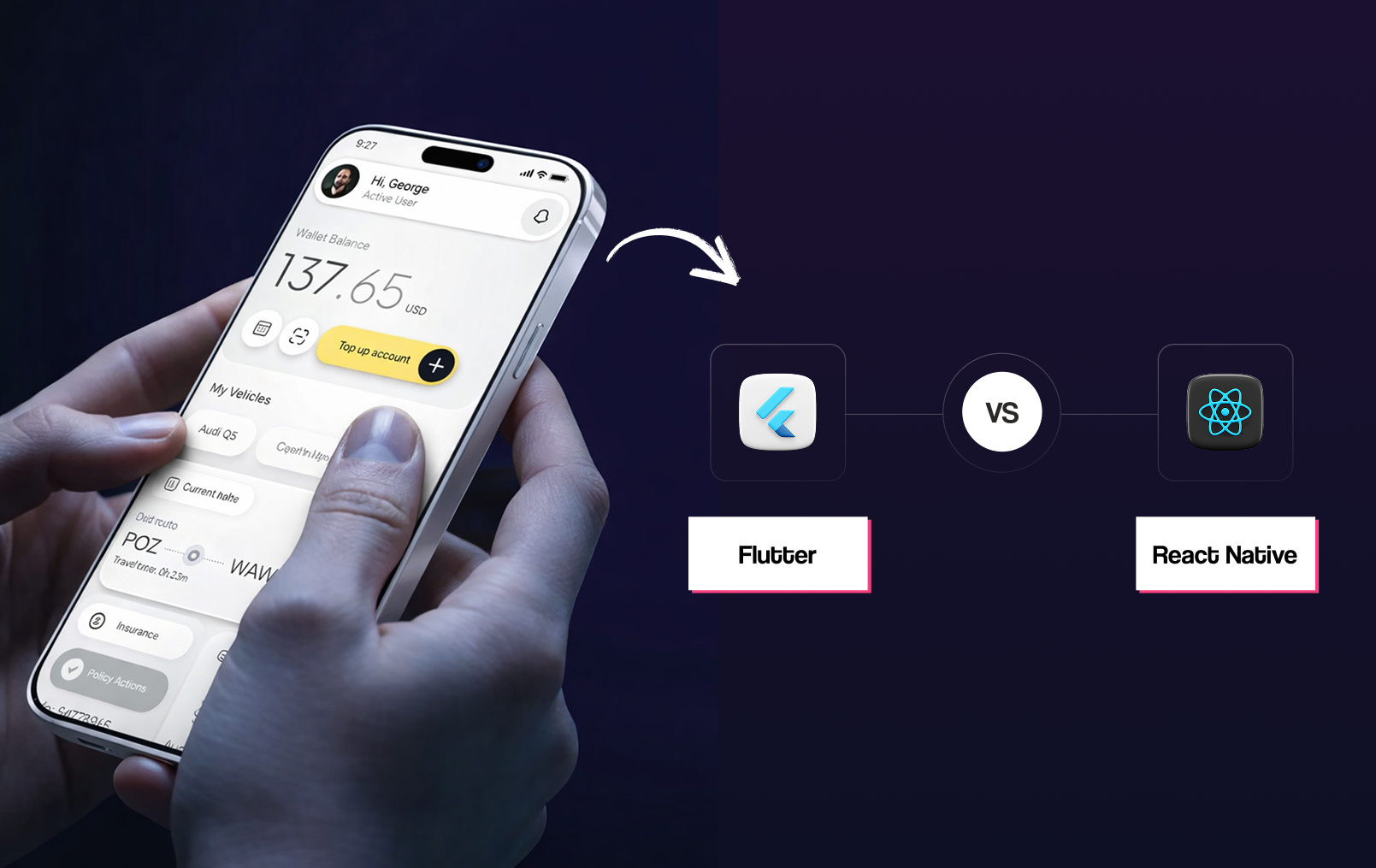
Choosing the right technology stack can make or break a new software project. When companies decide to build a mobile application, they face a critical fork in the road. They must decide between native development or cross platform app development. For most modern startups and enterprises, cross-platform frameworks offer the most practical path forward, allowing teams to deploy on both iOS and Android from a single codebase.
Two tech giants dominate this conversation: Google and Meta. As a leading mobile app development company, we constantly guide founders through the process of selecting between Google’s Flutter and Meta’s React Native. The decision impacts your immediate budget, your team's development speed, and your product's long-term scalability.
Comparing flutter vs react native performance, cost, and developer ecosystem is essential for building a successful product. This comprehensive guide breaks down the react native vs Flutter debate for 2026. You will learn the core differences, analyze performance metrics, and discover the best framework for mobile app development based on your specific business goals.
What is Flutter?
Flutter is an open-source UI software development kit created by Google. First released in 2017, it allows developers to build natively compiled applications for mobile, web, and desktop from a single codebase. It uses the Dart programming language, which Google also developed.
Unlike traditional frameworks, Flutter does not rely on web browser technology or native device components to render its user interface. Instead, it uses its own high-performance rendering engine to draw widgets directly onto the screen. This approach gives developers complete control over every pixel, ensuring a consistent look and feel across all devices and operating systems.
Key Features of Flutter
Flutter brings several unique advantages to the table for engineering teams. The framework relies on a highly customizable, widget-based architecture. Everything in Flutter is a widget, from layout structures like padding to interactive elements like buttons. This modularity makes building complex user interfaces highly efficient.
Another standout feature is the "Hot Reload" capability. Developers can inject updated source code files directly into the running Dart Virtual Machine. This means you can see the effects of code changes in milliseconds without losing the state of the app or needing to perform a full recompile. Furthermore, Flutter delivers near-native performance because Dart compiles directly to native ARM code for iOS and Android.
When to Use Flutter
Flutter works exceptionally well when your application requires a highly customized, brand-first user interface. If your design features intricate animations, custom typography, or unique visual layouts that do not rely on standard operating system components, Flutter handles this effortlessly.
We also recommend Flutter when you need absolute consistency across iOS and Android. Because Flutter renders its own UI, you do not have to worry about an iOS update breaking your application's layout. It is also an excellent choice when you plan to expand your application to desktop or web platforms in the future, as Flutter's multi-platform capabilities have matured significantly heading into 2026.
What is React Native?
React Native is a popular open-source UI software framework created by Meta Platforms (formerly Facebook). Launched in 2015, it allows developers to build mobile applications using JavaScript and React. It uses a bridge to translate JavaScript code into native platform-specific components.
Millions of developers already know JavaScript, making React Native highly accessible to web development teams transitioning to mobile. React Native powers some of the world's most widely used mobile applications, including Instagram, Discord, and Shopify. It focuses on utilizing standard UI blocks from iOS and Android, putting them together using JavaScript to create a genuine native experience.
Key Features of React Native
React Native thrives on its massive ecosystem and community. Because it runs on JavaScript, you have access to Node Package Manager (NPM), the largest software registry in the world. This gives your team access to thousands of pre-built libraries and tools, accelerating the development process significantly.
Like Flutter, React Native features a mechanism for rapid iteration called "Fast Refresh." It combines the benefits of hot reloading and live reloading, allowing developers to see changes instantly while retaining the component state.
React Native also utilizes true native components. A React Native View translates directly to a UIView on iOS and an android.view on Android, making the app feel entirely native to the end user.
Like Flutter, React Native features a mechanism for rapid iteration called "Fast Refresh." It combines the benefits of hot reloading and live reloading, allowing developers to see changes instantly while retaining the component state. React Native also utilizes true native components. A React Native View translates directly to a UIView on iOS and an android.view on Android, making the app feel entirely native to the end user.
When to Use React Native
You should choose React Native if you already have a strong team of web developers proficient in JavaScript or React. The learning curve is minimal for experienced web engineers. This makes it an ideal choice if you need to build an MVP for a startup quickly by leveraging your existing talent pool.
React Native is also preferable if your application relies heavily on native APIs or needs to integrate seamlessly with existing native code. If you are adding a mobile app to a deep web ecosystem, sharing business logic between a React web app and a React Native mobile app saves tremendous time. Finally, if you want your app to strictly adhere to the default design language of iOS (Human Interface Guidelines) and Android (Material Design), React Native pulls those native elements naturally.
Flutter vs React Native — Key Differences
Understanding the fundamental distinctions between these technologies helps clarify which aligns better with your business objectives. Here is a high-level comparison table outlining the core differences.
Flutter vs React Native Comparison Table
Feature | Flutter | React Native |
Programming Language | Dart | JavaScript / TypeScript |
Developer | Meta (Facebook) | |
UI Rendering | Custom Engine (Impeller/Skia) | Native OS Components via JS Bridge |
Performance | Near-native, highly optimized | Good, but the bridge can cause bottlenecks |
Development Speed | Fast (Hot Reload, vast widget library) | Fast (Fast Refresh, huge JS library ecosystem) |
Community Support | Rapidly growing, highly engaged | Massive, mature, extensive third-party packages |
Scalability | Excellent for complex UI and logic | Very good, but requires careful architecture planning |
Cost | Generally lower due to the single codebase efficiency | Generally lower, allows leveraging existing JS developers |
Performance Comparison
When evaluating flutter vs react native performance, we must look at how each framework interacts with the underlying device hardware. Both frameworks perform exceptionally well for standard applications, but differences emerge under heavy workloads.
Speed
Flutter generally edges out React Native in raw computational speed. Because Dart compiles directly to native machine code (ARM or x86), the device processor executes the instructions without any intermediary interpretation. This direct execution results in incredibly fast app startup times and smooth execution of background tasks.
React Native relies on a JavaScript engine running on the device. Historically, it used a bridge to communicate asynchronously between the JavaScript thread and the native thread. While Meta has introduced the new architecture (Fabric and TurboModules) to eliminate the bridge and improve speed, JavaScript still requires interpretation. This can lead to minor latency during complex computational tasks compared to Flutter's compiled code.
Rendering
Rendering is where Flutter truly shines. Flutter completely bypasses the native UI components of iOS and Android. Instead, it uses its own high-performance 2D rendering engine. In 2026, Google's new Impeller rendering engine provides buttery-smooth animations, virtually eliminating early frame drops and "jank."
React Native maps its components to the device's native UI elements. While this creates a 100% native feel, it means the framework must constantly translate instructions back and forth. If your application features highly complex animations, rapid screen transitions, or heavy graphics, React Native can sometimes struggle to maintain a consistent 60 or 120 frames per second.
Real-World Performance Summary

Development Speed & Productivity
Time-to-market is a critical factor for startups and established enterprises alike. Both frameworks drastically reduce development time compared to writing separate native codebases for iOS and Android. However, they achieve developer productivity in different ways.
Flutter offers a highly structured, "batteries-included" approach. Google provides a massive library of ready-to-use widgets that conform to both Material Design and Cupertino (iOS) guidelines. You do not have to spend time searching for third-party routing libraries or state management tools, as the official documentation covers almost everything. The Hot Reload feature allows teams to iterate on UI changes in real time.
React Native relies heavily on community-driven solutions. While the core framework is lightweight, you must install third-party packages for navigation, advanced state management, and complex animations. Finding the right packages and ensuring they remain maintained can slow down initial setup. However, because millions of developers know JavaScript, building a team and writing business logic is often faster for companies with an existing web background.
Cost Comparison
Building a mobile app requires a significant financial investment. As a software development company, we analyze how these frameworks impact both initial development and long-term maintenance budgets. Both options are inherently more cost-effective than native development because you only pay for one development team instead of two.
Development Cost
The initial cost to build a mobile app depends heavily on developer availability and hourly rates. JavaScript developers are abundant globally. This massive talent pool can sometimes make hiring React Native developers slightly cheaper or faster. If your company already employs React developers for your web applications, you can transition them to React Native with minimal training costs.
Flutter developers command competitive rates, but the framework's architecture often requires fewer hours to build complex, custom user interfaces. The comprehensive widget library means developers spend less time writing custom rendering code. You can explore a detailed breakdown of these expenses in our comprehensive guide on the cost to build a mobile app.
Maintenance Cost
Maintenance costs encompass bug fixes, library updates, and platform adaptations. React Native can carry a slightly higher long-term maintenance burden. Because it relies heavily on third-party NPM packages, you must regularly audit and update these dependencies. When iOS or Android releases a major OS update, native UI components change, which can occasionally cause React Native apps to render differently.
Flutter handles maintenance more predictably. Because it ships its own rendering engine, OS updates rarely break your application's layout. A Flutter app built today will look identical on a device three years from now, regardless of the underlying OS changes. This reduces the time QA teams spend testing layouts after major Android or Apple updates.
Cost Comparison Table
Cost Factor | Flutter | React Native |
Developer Availability | Growing rapidly, specialized | Extremely high, JS ubiquitous |
Initial Build Time | Fast, efficient UI building | Fast, leverage existing JS logic |
3rd Party Dependencies | Low (many built-in tools) | High (requires many external libraries) |
Long-term Maintenance | Lower (stable UI engine) | Moderate (dependency updates) |
UI/UX Comparison
User interface and user experience define how customers interact with your brand. The approaches Flutter and React Native take to UI construction are fundamentally different.
React Native uses native components. A toggle switch in React Native uses the actual iOS toggle switch on an iPhone and the actual Android toggle switch on a Pixel. This is perfect if your goal is an app that feels exactly like the native operating system. Users intuitively know how to interact with the standard UI elements they see every day.
Flutter draws every pixel itself. While it provides widgets that mimic native elements perfectly, its true strength lies in brand consistency. If you want your app to look the same on an iPhone 16 as it does on a Samsung Galaxy, Flutter guarantees this consistency. It allows designers to let their imaginations run wild with custom shapes, deep shadows, and complex animations without worrying about native constraints.
When to Choose Flutter
Based on our experience delivering app development services, Flutter is the optimal choice in several specific scenarios. Choose Flutter if your application design is highly custom and you want absolute visual consistency across all platforms.
It is also the right choice if your application requires complex, continuous animations or handles heavy data visualization. The Impeller rendering engine manages these tasks without dropping frames. Finally, if your long-term roadmap includes launching a desktop or web version of the application, Flutter's multi-platform compilation is highly robust in 2026.
When to Choose React Native
React Native remains a powerhouse for a variety of business needs. Choose React Native if you have a tight deadline and an existing team of strong JavaScript or React developers. The ability to share business logic between your web application and your mobile application is a massive advantage.
We also recommend React Native if your application relies heavily on device hardware features or needs to integrate deeply with legacy native codebases (Java/Kotlin or Objective-C/Swift). If your user base prefers an application that rigidly adheres to standard iOS and Android design paradigms, React Native delivers that authentic feel automatically.
Which is Better in 2026?
Determining the best framework for mobile app development depends entirely on your specific context. Neither framework is objectively "better" in a vacuum; they solve problems differently.
In 2026, Flutter has solidified its position as the premium choice for highly customized, high-performance, visually stunning applications. Its stability and ease of scaling make it incredibly attractive for new standalone products. React Native remains the undisputed king of integration and talent availability. It is the smartest business choice for companies deeply entrenched in the JavaScript ecosystem or those needing to spin up a team rapidly from existing web resources.
Visual Suggestions
To enhance the readability and engagement of this article, we suggest including the following images naturally throughout the text:
Flutter vs React Native comparison chart: A colorful infographic near the introduction highlighting market share and core differences.
App UI examples: Side-by-side screenshots showing a native-feeling React Native app versus a highly branded, custom Flutter app.
Development workflow: A visual diagram comparing Flutter's compiled architecture to React Native's JavaScript bridge architecture.
Performance comparison graphs: A bar chart illustrating startup times and frame rates under heavy animation loads.
Call to Action
Choosing the right technology stack is a complex decision that dictates your product's future. You do not have to make this decision alone.
Partner with iCode49 Technolabs. As a premier mobile app development company, our engineering teams possess deep expertise in both frameworks. Whether you need high-performance Flutter development to bring a custom design to life or scalable React Native development to leverage your existing ecosystem, we deliver secure, fast, and beautiful applications.
Ready to build your next big idea? Contact us today to discuss our mobile app development services and get a comprehensive technical consultation tailored to your business goals.
Conclusion
The debate over flutter vs react native cost, performance, and scalability will continue as both frameworks evolve. In 2026, the landscape of cross-platform app development offers two incredibly mature, enterprise-ready solutions.
To summarize, Flutter is your go-to framework for consistent, highly customized user interfaces and exceptional rendering performance. It guarantees your app looks identical across all platforms. React Native is the ideal choice for businesses looking to leverage existing JavaScript talent, share codebases with web platforms, and deliver a strictly native user experience.
Your final decision should evaluate your team's current skill set, your product's design requirements, and your long-term maintenance strategy. By carefully weighing these factors, you can confidently select the framework that will drive your mobile product to success.
 Ahmedabad, INDIA
 1214, Rashmi Prime, Besides STC Building, Vakil Saheb Bridge, Ambli, Ahmedabad, Gujarat – 380058
 USA
USA Dubai, UAE
 Singapore
 WhatsApp
 Gmail
Gmail Contact no


