



If you want to launch a digital product this year, the first question on your mind is likely: "What is the cost to build a mobile app in 2026?" Budgeting for software creation requires a clear understanding of the tools, technologies, and teams required to bring your vision to life.
Whether you lead a growing startup or manage operations for an established enterprise, understanding the financial landscape of app creation helps you make smart decisions. Development prices vary wildly—from $25,000 for a basic utility app to well over $200,000 for a complex, AI-driven platform.
In this complete guide, we will break down the exact costs, industry trends, and hidden fees associated with app development. By the end, you will know exactly how to budget your resources and why partnering with a trusted software development company ensures a strong return on your investment.
Why Mobile App Development Matters in 2026
Before we dive into the numbers, we must understand why businesses continue to invest heavily in mobile platforms. Smartphones dictate how consumers shop, communicate, and work. If your business lacks a mobile presence, you risk losing your audience to competitors who offer seamless on-the-go experiences.
Key Benefits of Building a Mobile App
Direct Customer Engagement: Apps provide a direct channel to your users. Through push notifications and personalized content, you can engage your audience instantly.
Increased Revenue Channels: E-commerce and subscription-based apps open new revenue streams. Mobile commerce is taking over traditional online shopping.
Brand Loyalty: A well-designed mobile app builds trust. When users have your icon on their home screen, your brand remains top-of-mind.
Data Collection: Apps allow you to gather valuable analytics on user behavior, helping you refine your marketing and sales strategies.
[Visual Suggestion: A workflow illustration showing the cycle of user acquisition, engagement, retention, and monetization through a mobile app.]
The True Cost to Build a Mobile App in 2026

Estimating the cost of an application requires looking at several moving parts. The final price tag depends on app complexity, platform choice (iOS, Android, or cross-platform), backend infrastructure, and your development team's location.
Here is a general cost breakdown based on app complexity:
App Complexity | Typical Features | Estimated Cost Range (USD) | Estimated Timeline |
Simple App | Basic UI, standard login, minimal backend, no integrations | $25,000 - $50,000 | 2 - 4 Months |
Medium App | Custom UI, API integrations, payment gateways, database | $50,000 - $120,000 | 4 - 7 Months |
Complex App | Real-time features, AI integration, high security, and custom animations | $120,000 - $300,000+ | 7 - 12+ Months |
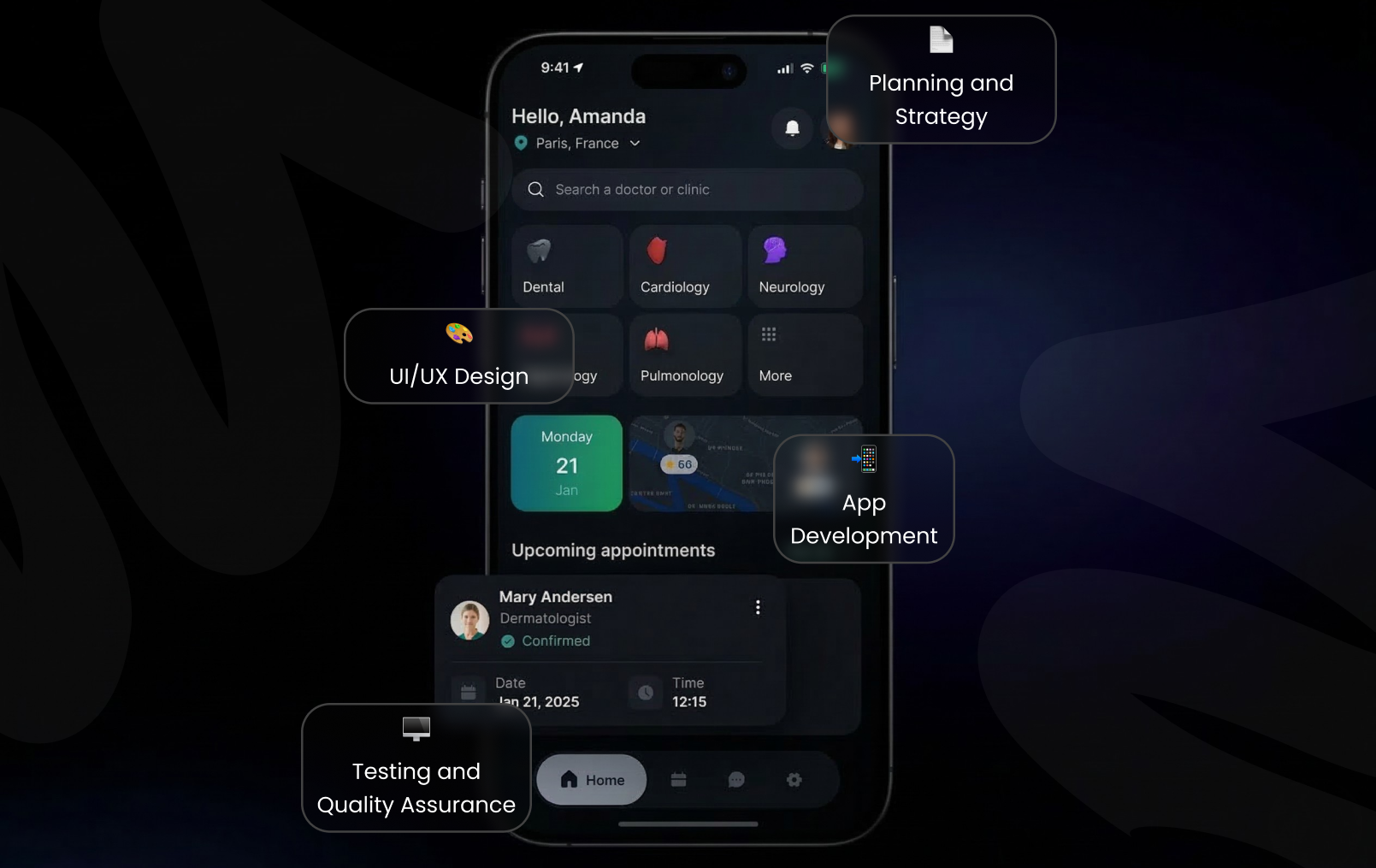
1. The Planning and Strategy Phase
Every great app starts with a solid plan. During the discovery phase, business analysts and product managers define the scope of your project. This includes market research, defining user personas, and creating a feature list.
Estimated Cost: $5,000 - $15,000
2. UI/UX Design
Users demand intuitive, visually appealing interfaces. The design phase involves creating wireframes, interactive prototypes, and the final visual design. A complex design with custom animations will naturally cost more than a standard, template-based interface.
Estimated Cost: $10,000 - $25,000
[Visual Suggestion: A split-screen graphic showing a basic wireframe on the left and the polished, high-fidelity UI/UX screen on the right.]
3. App Development (Coding)
This is the most resource-intensive phase. When you hire a mobile app development company, their engineers write the code for both the frontend (what users see) and the backend (servers, databases, and APIs).
Native Development: Building separately for iOS (Swift) and Android (Kotlin) offers the best performance but doubles the development effort.
Cross-Platform Development: Using frameworks like Flutter or React Native allows developers to write one codebase for both platforms, saving time and money.
Estimated Cost: $20,000 - $150,000+
4. Testing and Quality Assurance (QA)
Before launching, QA engineers rigorously test the app to find and fix bugs. They check for performance, security vulnerabilities, and device compatibility.
Estimated Cost: $5,000 - $20,000
How Team Location Impacts Pricing
The hourly rate of developers plays a massive role in your budget. Where your team is located dictates a large portion of the cost.
Region | Average Hourly Rate (USD) | Best Suited For |
North America (USA, Canada) | $100 - $250+ | Highly complex projects requiring strict local compliance |
Western Europe & UK | $80 - $150 | Premium design and solid engineering |
Eastern Europe | $50 - $100 | Excellent balance of quality and cost |
Asia (India, Vietnam) | $30 - $70 | Budget-friendly development with scalable teams |
Working with a global software development company like iCode49 Technolabs gives you access to top-tier talent while optimizing your budget effectively.
Industry Examples: What Do Different Apps Cost?
To give you a clearer picture, let us examine the cost to build specific types of apps in 2026.
E-commerce Applications
Retail apps need product catalogs, shopping carts, secure payment gateways, and user profiles. They also require robust inventory management on the backend.
Cost Range: $60,000 - $150,000
Must-Have Features: Push notifications, Apple Pay/Google Pay integration, order tracking.
Healthcare & Telemedicine Apps
Healthcare apps require strict regulatory compliance (like HIPAA in the USA). They often include video conferencing for virtual appointments, secure messaging, and electronic health record (EHR) integrations.
Cost Range: $80,000 - $200,000+
Must-Have Features: End-to-end encryption, video streaming, and appointment scheduling.
Fintech & Banking Apps
Financial applications demand the highest level of security. They process sensitive data and require complex integrations with banking APIs.
Cost Range: $100,000 - $300,000+
Must-Have Features: Biometric login, real-time transaction processing, and AI fraud detection.
Mobile App Development Trends for 2026
The technology landscape evolves rapidly. To keep your application relevant and competitive, you must embrace the latest trends. Here is what is driving app development this year.
Artificial Intelligence and Machine Learning
AI is no longer an optional feature; it is a user expectation. Apps now use AI to offer personalized recommendations, voice recognition, and automated customer support through chatbots. If you plan to build a smart application, investing in AI development services is highly recommended. Predictive analytics can drastically improve user retention by anticipating what the user wants before they even ask.
5G Technology Integration
The widespread adoption of 5G networks allows mobile apps to process data at unprecedented speeds. This means AR/VR features, high-definition video streaming, and real-time cloud gaming can run smoothly on mobile devices without draining battery life or causing lag.
Internet of Things (IoT)
Apps now connect with smartwatches, home security systems, and industrial equipment. Building an app that acts as a remote control for IoT hardware requires specialized backend architecture to handle continuous data streams securely.
No-Code and Low-Code Development
For startups looking to build a Minimum Viable Product (MVP) quickly, low-code platforms offer a faster route to market. While these tools do not replace the need for custom software development when building highly complex systems, they help validate business ideas at a lower initial cost.
Hidden Costs of App Development
Many business owners make the mistake of only budgeting for the initial build. However, the cost to build a mobile app in 2026 goes beyond launch day. You must account for ongoing expenses:
Server and Hosting Fees: Your app needs a place to store data. Cloud hosting (like AWS, Google Cloud, or Azure) costs anywhere from $50 to $1,000+ per month, depending on your user base.
Maintenance and Updates: Operating systems (iOS and Android) update frequently. You must update your app to remain compatible. Expect to spend 15% to 20% of your initial development cost annually on maintenance.
Third-Party APIs: If your app uses Google Maps, Stripe for payments, or Twilio for SMS, you will pay subscription or usage fees. When selecting a payment API for a mobile app, developers should also compare supported payment methods, transaction fees, security requirements, regional availability, SDK quality, and integration complexity because these factors can affect both development costs and ongoing operating expenses.
App Store Fees: Apple and Google charge $99 and $25, respectively, to register developer accounts. They also take a percentage of in-app purchases.
Marketing and User Acquisition: Building the app is only half the battle. You need a dedicated budget to market your product and acquire users through ads, SEO, and social media.
Choosing the Right Mobile App Development Services
Selecting the right partner dictates the success of your software project. You can choose between freelancers, an in-house team, or an agency.
For most businesses, hiring an established software agency provides the best balance of reliability, diverse skill sets, and accountability. A professional agency brings a dedicated project manager, QA testers, UI/UX designers, and developers under one roof. They ensure your project stays on schedule and within budget.
When evaluating potential partners, look for:
A strong portfolio of past work in your specific industry.
Transparent pricing and clear communication practices.
Post-launch support and maintenance packages.
Expertise in modern technologies, including AI, cloud infrastructure, and cross-platform frameworks.
Ready to Bring Your App Idea to Life?
Understanding the cost to build a mobile app in 2026 is the crucial first step in your digital journey. While the investment is significant, a well-executed application drives revenue, builds brand loyalty, and streamlines your business operations.
You need a technology partner who understands your goals and has the technical expertise to deliver a flawless product. At iCode49 Technolabs, we specialize in transforming innovative ideas into high-performance digital solutions.
Let's build something extraordinary.
Contact iCode49 Technolabs today for top-tier mobile app development services and get a custom quote for your project.
Conclusion
Determining the cost to build a mobile app in 2026 comes down to your specific business requirements, feature complexity, and the technical partner you choose. From UI/UX design and development to maintenance, third-party integrations, and choosing the right payment API for your mobile app, each decision can affect both your initial budget and ongoing costs. Planning these requirements early helps create a realistic budget aligned with your business goals.
As technology advances with AI integrations, 5G capabilities, and cross-platform frameworks, mobile applications continue to create new opportunities for businesses. Whether you are building an e-commerce app, subscription service, or another digital product, selecting secure and cost-effective APIs alongside a reliable development team can improve the user experience and long-term scalability. Take the time to define your requirements, account for hidden costs, and choose the right technology partner to build an app that supports sustainable growth.
 Ahmedabad, INDIA
 1214, Rashmi Prime, Besides STC Building, Vakil Saheb Bridge, Ambli, Ahmedabad, Gujarat – 380058
 USA
USA Dubai, UAE
 Singapore
 WhatsApp
 Gmail
Gmail Contact no


