


Founders often pour months of effort and hundreds of thousands of dollars into building a flawless product, only to launch and hear nothing but crickets. You assume you know exactly what your target audience wants, but the market reacts differently. This exact scenario explains why a staggering number of startups fail within their first few years. Building a massive, feature-heavy application without testing the core concept first is a high-risk gamble.
To mitigate this risk, successful founders rely on a Minimum Viable Product (MVP). An MVP is the most basic version of your product that still delivers the core value proposition to early adopters. It allows you to test your hypothesis, gather real user feedback, and iterate before committing major resources to full-scale development.
Building an MVP in 2026 is more critical than ever. Markets shift rapidly, user expectations evolve constantly, and venture capitalists demand proven traction before writing checks. By focusing on a minimum viable product, you validate your business model early. You save massive amounts of time and money, ensuring you build something people actually want to buy. This comprehensive guide will walk you through the entire MVP development process, including costs, timelines, and exactly how to turn your raw idea into a validated, scalable business.
What is an MVP?
A Minimum Viable Product (MVP) is a product with just enough features to attract early-adopter customers and validate a product idea early in the product development cycle. The concept, popularized by Eric Ries in "The Lean Startup," focuses on maximum learning with minimum effort. You strip away all the bells and whistles, leaving only the primary function that solves your target customer's main problem.
Many founders mistakenly believe an MVP means a buggy, half-finished product. That is entirely incorrect. An MVP must be functional, reliable, and usable. The "minimum" refers to the scope of features, not the quality of the software. If your core feature does not work well, users will abandon the app, and you will not gather the accurate data needed to validate your idea.
Let us look at a few prominent minimum viable product examples that grew into massive global enterprises:
Uber: When Uber first launched as "UberCab," it did not have fare splitting, gamification, or different vehicle tiers. It simply connected iPhone users in San Francisco with a black car service and handled the payment via credit card. It solved one problem: getting a reliable ride quickly.
Airbnb: The founders of Airbnb could not afford rent. They set up a simple webpage offering air mattresses in their living room and a homemade breakfast for attendees of a local design conference. This basic website proved that people were willing to pay to sleep in a stranger's home, validating their billion-dollar concept.
Dropbox: Instead of building complex infrastructure right away, the Dropbox founder created a simple three-minute explainer video demonstrating how the file-syncing software would work. This video drove hundreds of thousands of signups overnight, proving immense market demand before writing the heavy backend code.
Why Startups Should Build MVP First
Jumping straight into full product development is incredibly risky. Partnering with a skilled software development company to build an MVP first provides several distinct advantages that can make or break your startup.
Massive Cost Saving
Developing a comprehensive application with dozens of features requires a large team of developers, designers, and project managers working for many months. This burns through your capital rapidly. An MVP requires a fraction of that investment. By building only the core features, you keep initial expenses low. You can then use the remaining capital to market the product, acquire users, and fund future development based on actual revenue or user data.
Faster Launch and Time-to-Market
You need to get your product into the hands of real users as quickly as possible. An MVP allows you to launch in a matter of months rather than years. This speed gives you a competitive advantage, allowing you to establish a brand presence, secure early adopters, and begin generating buzz while competitors are still stuck in the planning phases.
Idea Validation and User Feedback
An MVP acts as a testing mechanism. You learn exactly how users interact with your software. You will discover that features you thought were vital are completely ignored, while secondary features become the main attraction. This raw, unfiltered feedback dictates your product roadmap. You pivot and adapt based on data rather than assumptions.
Attracting Investors
Venture capitalists and angel investors rarely fund raw ideas in 2026. They want to see traction, user engagement, and a proven product-market fit. A working MVP demonstrates your ability to execute. When you approach investors with a functional app and a growing base of active users, your chances of securing seed funding skyrocket.
MVP vs Full Product
Understanding the distinction between an MVP and a fully developed application is crucial for managing scope and setting realistic expectations for your startup app development process. An MVP focuses on viability and speed. A full product focuses on comprehensive solutions, scalability, and broad market appeal.
Below is a detailed comparison table illustrating the key differences.
Feature / Aspect | Minimum Viable Product (MVP) | Full Product |
Primary Goal | Validate the idea and gather feedback | Maximize revenue, user retention, and market share |
Feature Set | Only core functionalities | Comprehensive, advanced feature sets |
Target Audience | Early adopters and beta testers | Broad market and mainstream users |
Development Time | 2 to 4 months | 6 to 18+ months |
Investment Cost | Low to Moderate ($20K – $60K) | High ($100K – $500K+) |
Design / UX | Simple, clean, functional | Highly polished, custom animations, intricate UI |
Risk Level | Low (Minimal capital at risk) | High (Heavy upfront investment) |
Scalability | Designed for the initial user base | Highly scalable architecture for millions of users |
Step-by-Step MVP Development Process
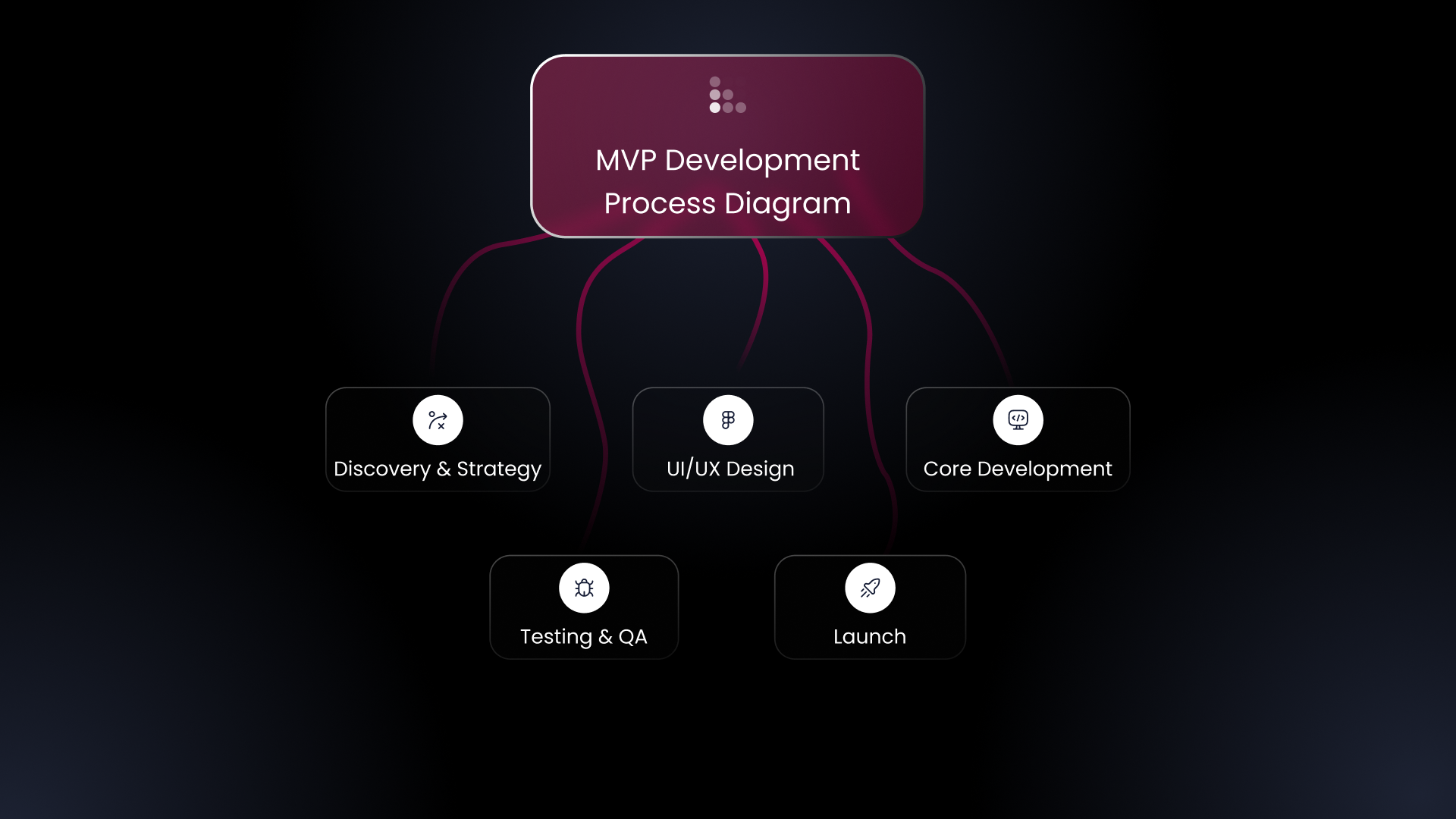
Building an MVP requires a structured, disciplined approach. Skipping steps leads to scope creep, wasted resources, and ultimately, startup failure. Here is the proven, step-by-step startup app development process we use to build successful products.
1. Idea Validation and Market Research
Before writing a single line of code, you must confirm that a market exists for your solution. Identify your target audience and understand their pain points. Conduct surveys, interview potential customers, and analyze competitors. If your proposed solution does not significantly improve upon existing alternatives, you need to refine your concept. Define the exact problem you are solving and precisely who you are solving it for.
2. Define Core Features
Once you validate the problem, map out the user journey. What steps must a user take to achieve their goal using your software? List every single feature you can think of, then ruthlessly cut them down. Categorize features into "Must-have," "Nice-to-have," and "Future roadmap." Your MVP should strictly consist of the "Must-have" list. If a feature does not directly support the core value proposition, remove it from this phase.
3. Wireframing and Prototyping
Next, visualize the product. Create wireframes, which are basic black-and-white sketches of your app's screens. This helps you figure out the layout, user flow, and navigation. Once the wireframes make sense, upgrade them to an interactive prototype. A prototype looks like the real app but does not have a functional backend. You can use tools like Figma to create clickable prototypes, allowing you to test the user experience before development begins.
4. Development
With a clear blueprint in hand, the actual coding begins. This is where partnering with an experienced mobile app development company pays off. Developers will build the frontend (what the user sees) and the backend (the servers and databases powering the app). For an MVP, agility is key. Developers often use modern frameworks that allow for rapid deployment across multiple platforms simultaneously.
5. Rigorous Testing
Never launch an untested MVP. Just because it is a minimal product does not mean it can be broken. Quality Assurance (QA) engineers must test the software rigorously. They will perform functional testing, usability testing, and performance testing to ensure the app works smoothly under basic load. Fixing bugs during this phase prevents negative reviews and user frustration upon launch.
6. Launch and Gather Feedback
Deploy the app to the Apple App Store, Google Play Store, or web servers. Your job is not done; it has just begun. Monitor user behavior closely using analytics tools. Encourage users to leave feedback, report bugs, and suggest features. This data is the goldmine you built the MVP to acquire.
7. Iterate and Improve
Analyze the feedback and data. Did users use the app the way you expected? What features did they struggle with? Use these insights to plan your next development sprint. You will continually build, measure, and learn, gradually evolving your MVP into a robust, full-scale product.
MVP Development Cost in 2026
Budgeting accurately is vital for founders. How much does it cost to build an MVP? In 2026, a standard software or mobile app MVP typically costs between $20,000 and $60,000.
The exact price depends heavily on the complexity of your idea, the platforms you target (iOS, Android, Web), and the geographic location of your development team. Building an app with basic user authentication, a central feed, and a simple database will sit at the lower end of that spectrum. An MVP requiring real-time geolocation, complex AI algorithms, or high-security data compliance will push toward the higher end.
Here is a general breakdown of how those costs are distributed across the project lifecycle:
MVP Phase | Estimated Cost Range | Percentage of Budget |
Research & UI/UX Design | $3,000 – $8,000 | 10% - 15% |
Frontend & Backend Development | $12,000 – $40,000 | 60% - 70% |
QA Testing & Bug Fixing | $3,000 – $7,000 | 10% - 15% |
Deployment & Launch | $1,000 – $3,000 | 5% |
Post-Launch Support (1-2 months) | $1,000 – $2,000 | 5% |
For a more comprehensive look at budgeting your tech project and understanding hourly rates and platform variables, check out our complete guide on the cost to build a mobile app.
Timeline to Build MVP
Speed is the whole point of an MVP. If your MVP takes a year to build, you are over-engineering it. A realistic timeline for building an MVP ranges from 8 to 16 weeks (2 to 4 months).
Here is a standard MVP development timeline table:
Development Phase | Time Required | Key Deliverables |
Phase 1: Discovery & Strategy | 1 - 2 Weeks | Market research, feature prioritization, project roadmap |
Phase 2: UI/UX Design | 2 - 3 Weeks | Wireframes, user flows, interactive prototypes |
Phase 3: Core Development | 4 - 8 Weeks | Frontend code, backend architecture, API integrations |
Phase 4: Testing & QA | 1 - 2 Weeks | Bug reporting, performance checks, security audits |
Phase 5: Launch | 1 Week | App store submission, server deployment |
If you attempt to squeeze this timeline further, you risk compromising the functional quality of the core feature. If it extends beyond 16 weeks, you need to re-evaluate your scope and cut more non-essential features.
Best Tech Stack for MVP Development
Choosing the right technology stack ensures your MVP is built quickly but can still handle initial growth. You want technologies that are flexible, supported by large developer communities, and allow for rapid iteration.
Flutter & React Native: For mobile apps, cross-platform frameworks are the gold standard for MVPs. Instead of writing two separate codebases for iOS and Android, Flutter and React Native allow developers to write code once and deploy it across both platforms. This drastically cuts development time and costs while maintaining native-like performance.
Node.js & Python: For backend development, Node.js is incredibly fast and handles multiple concurrent connections effortlessly. Python, paired with frameworks like Django or FastAPI, allows for rapid development and is especially powerful if your MVP includes AI or machine learning components.
React.js & Vue.js: If you are building a web-based MVP, these frontend frameworks offer dynamic, responsive user interfaces that feel fast and modern.
Cloud Hosting (AWS, Firebase, Supabase): Avoid building custom servers. Use Backend-as-a-Service (BaaS) solutions like Firebase or Supabase for rapid database setup, user authentication, and hosting. As you scale, you can easily transition to more complex AWS or Google Cloud architectures.
Common MVP Mistakes Startups Make
Even with a solid plan, founders often fall into traps that derail their MVP efforts. Avoid these critical mistakes:
1. Over-engineering the Product
Founders often struggle to let go of their grand vision. They keep adding "just one more feature" before launch. This leads to scope creep, inflated budgets, and delayed launches. Be ruthless. If it is not absolutely essential, save it for version 2.0.
2. Ignoring the Target Audience
You are building the product for your users, not for yourself. Founders sometimes ignore negative feedback because they are too attached to their original idea. Let the data drive your decisions.
3. Choosing the Wrong Development Partner
Hiring cheap, unverified freelancers can result in sloppy code that has to be completely rewritten later. Engaging professional MVP development services ensures your code architecture is solid, secure, and ready to scale.
4. Focusing on Perfection Over Function
Your MVP does not need custom, award-winning animations. It needs to work. Spend your budget on ensuring the core functionality is flawless rather than obsessing over minute visual details.
When to Scale from MVP to Full Product
Once your MVP is live, how do you know it is time to build out the rest of the application? You should begin scaling when you hit specific milestones that prove your business model is viable.
Look at your user retention rates. If users download the app, use it once, and delete it, you have not achieved product-market fit. You need to iterate on the MVP. However, if you see consistent daily or weekly active users, people are finding real value in your solution.
Revenue is another massive indicator. If customers are willing to pay for your basic product, it is time to invest in expanding its capabilities. Furthermore, if your MVP successfully helps you secure venture capital or angel funding, you now have the resources required to scale.
When you reach this stage, you will transition from testing to growth. You will require comprehensive custom software development to build a robust backend, implement advanced security protocols, and integrate the "nice-to-have" features your users are actively requesting. Professional mobile app development services can seamlessly guide you through this transition, turning your validated MVP into an industry-leading platform.
Conclusion
Building a startup is inherently risky, but your development strategy does not have to be. By focusing on a Minimum Viable Product, you protect your capital, validate your ideas with real-world data, and drastically shorten your time to market. An MVP proves that your concept works, helps you secure vital investor funding, and ultimately ensures you achieve a much higher return on investment.
Stop guessing what your customers want and start proving it. Whether you are building the next disruptive fintech platform, an innovative healthcare solution, or a powerful AI tool, starting small is the smartest way to grow big.
Are you ready to turn your startup idea into reality?
Contact iCode49 Technolabs today. Our expert team specializes in rapid MVP development, full-scale mobile app development, and cutting-edge AI solutions tailored specifically for ambitious founders. Let us build a product your users will love. Get in touch with us now to discuss your vision!
 Ahmedabad, INDIA
 1214, Rashmi Prime, Besides STC Building, Vakil Saheb Bridge, Ambli, Ahmedabad, Gujarat – 380058
 USA
USA Dubai, UAE
 Singapore
 WhatsApp
 Gmail
Gmail Contact no


