



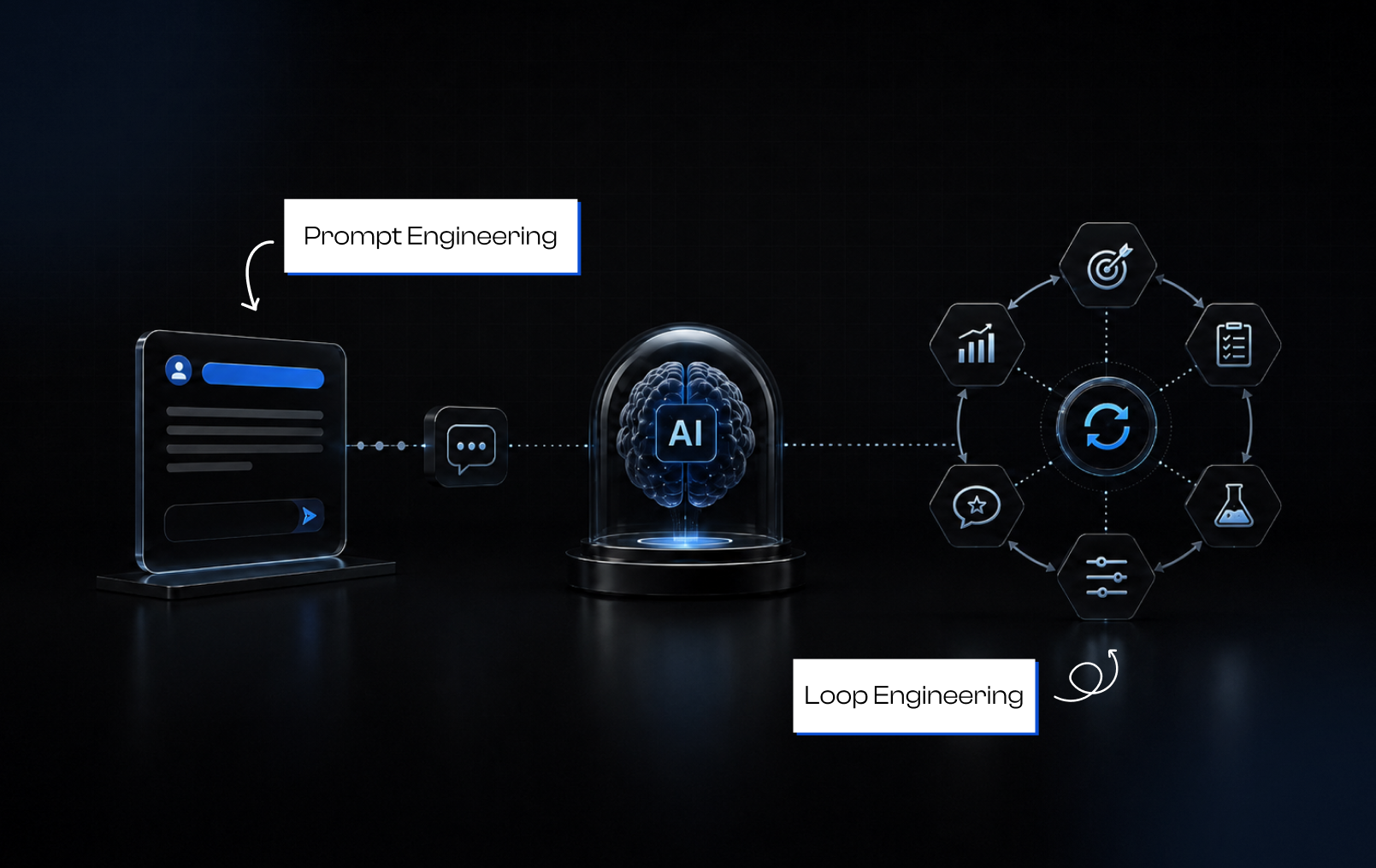
The answer depends on what you expect AI to do.
If you're evaluating AI development services or planning to build an AI-powered product, understanding the difference between Prompt Engineering and Loop Engineering is essential. Prompt Engineering is the right investment for AI applications that generate content, answer questions, or assist users. However, if your goal is to build AI agents that can use tools, make decisions, verify results, and complete multi-step workflows autonomously, Loop Engineering is becoming the more valuable approach.
The reality is that businesses aren't replacing Prompt Engineering with Loop Engineering. They're moving from building AI that responds to building AI that completes work.
This guide explains how the two approaches differ, where each delivers the highest business value, and how to choose the right strategy for your AI projects in 2026 whether you're building an in-house solution or partnering with an AI development company.
Quick view on Prompt Engineering vs. Loop Engineering:
Prompt Engineering is best for chatbots, content generation, and AI assistants, while Loop Engineering enables AI agents to execute complex workflows using planning, tool orchestration, memory, and verification. Most enterprise AI systems combine both approaches to build reliable, scalable AI applications.
The Evolution of AI Development (2023–2026)
The way businesses build AI applications has changed dramatically over the past four years. Early adoption focused on getting better answers from language models. Today, the focus is on building AI systems that can plan, use tools, verify their work, and complete business tasks with minimal human intervention.
2023: Better Prompts Produced Better Results
When ChatGPT and GPT-4 entered the mainstream, most organizations experimented with AI for content creation, customer support, coding assistance, document summarization, and knowledge search.
Teams quickly realized that how they instructed the model often mattered as much as the model itself. Techniques such as role prompting, few-shot prompting, and structured prompts consistently improved response quality, making Prompt Engineering one of the most valuable AI skills during the early generative AI wave.
Google, OpenAI, and Anthropic have since published official prompting guides demonstrating how prompt design directly influences accuracy, reasoning, and structured outputs, reinforcing prompt engineering as a foundational capability rather than a temporary trend.
2024: AI Became Connected to Business Systems
As businesses moved beyond experimentation, they discovered a major limitation: standalone chatbots could answer questions but couldn't interact with business applications or access proprietary knowledge.
To overcome this, organizations increasingly adopted Retrieval-Augmented Generation (RAG), function calling, and structured outputs. These capabilities enabled AI to retrieve information from internal documents, call APIs, query databases, and return responses in predictable formats.
Rather than simply generating text, AI became capable of participating in real business workflows by combining language models with enterprise systems and external tools. Anthropic describes this evolution as the transition from standalone language models to augmented LLMs equipped with retrieval, memory, and tool use.
2025: The Rise of AI Agents
The next breakthrough wasn't a larger language model—it was a different way of building AI applications.
Instead of asking AI to answer one question at a time, businesses began deploying AI agents capable of completing entire workflows.
For example, a software engineering agent can analyze a repository, write code, execute tests, fix failures, update documentation, and request human approval before deployment. Similar patterns are emerging across customer support, finance, legal operations, and enterprise automation.
According to Anthropic, the most effective production systems combine planning, tool use, retrieval, and memory rather than relying on a single prompt. The company also emphasizes that developers should begin with simple workflows and introduce autonomous agents only when task complexity requires dynamic decision-making.
2026: The Focus Shifts to Reliable AI Systems
As AI agents became capable of handling increasingly complex tasks, businesses encountered a new challenge: reliability.
An agent that can generate code, query databases, or execute workflows also needs mechanisms to verify results, recover from failures, maintain context, and know when to stop or request human intervention.
This challenge has led to growing interest in Loop Engineering, an emerging engineering approach focused on designing reliable execution loops rather than optimizing individual prompts. Instead of asking "How can we write a better prompt?", engineers are asking "How can we build an AI system that consistently achieves the correct outcome?"
Recent discussions among engineers at OpenAI, Anthropic, and the broader AI community describe this shift as moving from prompt-centric development to agent orchestration, where planning, verification, memory, retries, and tool coordination become first-class engineering concerns.
What Is Prompt Engineering?
Prompt Engineering is the process of designing clear, structured instructions that help a Large Language Model (LLM) generate more accurate, relevant, and consistent outputs. Instead of relying on a generic request, prompt engineering provides the AI with the context, role, constraints, and expected format needed to perform a task effectively.
At its core, prompt engineering is about reducing ambiguity. The more clearly you define the objective, context, and expected output, the more likely the model is to produce useful results. Both OpenAI and Anthropic recommend providing explicit instructions, relevant context, and output constraints to improve response quality and reliability.
Example
Instead of writing:
"Write a follow-up email."
A well-engineered prompt would be:
"You are a B2B SaaS Account Manager. Write a professional follow-up email after a product demo. Highlight three business benefits, address a pricing concern, and end with a call-to-action to schedule the next meeting. Keep the email under 200 words.
Although both prompts ask for the same task, the second provides enough context for the model to produce a response that's more aligned with the business objective."
Core Techniques Used in Prompt Engineering
Modern prompt engineering is more than writing longer prompts. It combines several techniques depending on the task:
1. Role Prompting
Role prompting assigns the AI a specific identity, expertise, or perspective to influence how it responds. By defining a role, businesses can make AI outputs more relevant and aligned with specific professional requirements.
2. Few-Shot Prompting
Few-shot prompting improves AI consistency by providing examples of desired inputs and outputs before asking the model to complete a new task. These examples help the AI understand patterns, formatting, tone, and expected response behavior.
3. Structured Outputs
Structured outputs instruct AI models to return information in a predefined format such as JSON, XML, Markdown tables, or specific templates. This makes AI responses easier to process, integrate, and automate within business systems.
4. Prompt Chaining
Prompt chaining breaks complex tasks into smaller, sequential steps instead of asking the AI to solve everything in a single prompt. Each step builds on the previous output, improving accuracy and reliability.
5. Tool Instructions
Tool instructions guide AI models on when and how to use external tools, APIs, databases, or software systems. This allows AI applications to perform actions beyond generating text.
6. Output Constraints
Output constraints define specific rules for how AI should generate responses, including tone, length, language, structure, or formatting requirements.
7. Retrieval-Augmented Generation (RAG)
Retrieval-Augmented Generation (RAG) combines AI models with external knowledge sources such as company databases, documents, or real-time information systems. Instead of relying only on training data, the AI retrieves relevant information and uses it to generate more accurate responses.
These techniques remain fundamental because every AI assistant and autonomous AI agent still relies on prompts to reason, plan, use tools, and communicate with users.
Where Prompt Engineering Reaches Its Limits
Workflow Automation:
Prompt engineering delivers excellent results when an AI needs to generate one response for one request. However, it becomes less effective when the objective shifts from answering a question to completing an end-to-end business workflow.
For example, consider this instruction:
Analyze our CRM, identify customers at risk of churn, generate personalized follow-up emails, update Salesforce, notify the account manager, and prepare a weekly executive report.
This isn't a single prompting task—it's a workflow orchestration problem involving multiple decisions, external systems, and validation steps.
Multiple Systems and Tool Integration:
Modern business processes rarely exist in one application. A single workflow may require AI to retrieve customer data from a CRM, search internal documentation, call APIs, update databases, generate reports, and send notifications across collaboration tools.
While modern LLMs support function calling and tool use, coordinating these actions reliably requires orchestration beyond a single prompt. Anthropic recommends using workflow and agent architectures for tasks that involve dynamic decision-making, tool usage, and iterative execution rather than relying on increasingly complex prompts.
No Built-in Verification:
A prompt can instruct an AI to perform multiple actions, but it cannot reliably verify whether those actions were completed successfully.
For example:
Did the API return the expected response?
Was the CRM record updated correctly?
Did the email send successfully?
Were duplicate customers filtered?
Should the task retry after a temporary failure?
Answering these questions requires evaluation logic, retries, and conditional decision-makingcapabilities that belong to the workflow surrounding the model rather than the prompt itself.
Limited Memory and Context Management:
Business workflows often span several minutes or even hours and involve multiple decisions along the way.
A single prompt isn't designed to maintain long-running state, remember previous execution steps, recover after interruptions, or resume unfinished tasks. These capabilities require persistent memory and workflow state management, which are core characteristics of modern AI agent architectures rather than prompt engineering alone.
Scalability Challenges:
As organizations continue adding more instructions, exceptions, and business rules to a single prompt, it quickly becomes difficult to understand, maintain, test, and improve.
Instead of increasing reliability, oversized prompts often introduce conflicting instructions, inconsistent outputs, and unpredictable behavior.
OpenAI recommends breaking complex objectives into structured workflows with clear reasoning steps, tool execution, and evaluation instead of relying on one monolithic prompt.
Expert Insight:
Prompt Engineering isn't becoming obsolete but it's becoming one component of a larger AI architecture.
Every successful AI agent still depends on carefully designed prompts for reasoning, planning, and communication. The difference is that those prompts now operate inside systems capable of retrieving information, calling tools, verifying outputs, maintaining memory, recovering from failures, and involving humans when necessary.
In other words, Prompt Engineering helps an AI generate better responses, while agent workflows help AI deliver reliable business outcomes.
What Is Loop Engineering?
Loop Engineering is an emerging approach to building AI agents that can complete multi-step tasks instead of generating a single response. Rather than focusing only on writing better prompts, it focuses on designing how an AI plans, uses tools, verifies results, remembers previous actions, recovers from failures, and decides whether to continue or stop.
In simple terms:
Prompt Engineering answers:"How do we get a better response from the model?"
Loop Engineering answers:"How do we build an AI system that reliably completes the entire task?"
This shift reflects the broader move toward agentic AI, where language models are combined with planning, tool calling, memory, and evaluation to perform real business work. Anthropic and OpenAI both describe modern AI agents as systems that coordinate models with external tools and iterative workflows rather than relying on a single prompt.
Core Components of a Loop Engineering Workflow
Unlike a traditional chatbot that generates one answer and stops, an AI agent repeatedly evaluates its progress until it reaches a defined goal.
A production workflow typically follows this sequence:
Each stage serves a specific purpose.
Planning
Before taking action, the AI breaks a complex objective into smaller tasks and determines the most efficient execution path. This reduces unnecessary reasoning and improves consistency for long-running workflows.
Tool Execution
Instead of relying only on its training data, the AI interacts with external systems such as CRMs, APIs, databases, search engines, and business applications to retrieve information or perform actions.
Verification
After completing each step, the system checks whether the expected outcome was achieved.
For example:
Did the API return valid data?
Did the code compile successfully?
Was the CRM updated correctly?
Is another retry required?
Without verification, an AI system has no reliable way to determine whether it has actually completed the task.
Memory
Unlike standalone prompts, AI agents maintain context across multiple interactions.
Memory enables an agent to remember previous actions, avoid repeating failed steps, and continue long-running workflows without starting from scratch.
Retry and Recovery
Failures are inevitable in production environments.
Instead of terminating immediately, well-designed agent systems analyze why a task failed, modify their approach, retry safely, or escalate to a human when confidence falls below an acceptable threshold.
This iterative plan → act → verify → improve cycle is increasingly common in coding agents, enterprise automation platforms, and research assistants.
Prompt Engineering vs. Loop Engineering
 Primary Goal
Prompt Engineering:
The objective is to help the AI generate the most accurate and relevant response for a single request. Once the model produces an answer, the interaction is generally complete.
Loop Engineering:
The objective extends beyond generating text. The AI is expected to complete an entire business process, which may involve planning tasks, using external tools, validating results, and continuing until the defined objective is achieved.
Execution Model
Prompt Engineering:
Every interaction is typically independent. The user provides a prompt, the model generates a response, and the conversation ends unless another prompt is submitted.
Loop Engineering:
The AI follows a structured workflow where each step depends on the outcome of the previous one. Instead of stopping after one response, it continuously evaluates progress, performs additional actions, and repeats the process until the task is completed.
Planning
Prompt Engineering:
The user determines the workflow in advance by describing every instruction within the prompt. The model executes those instructions but does not independently redesign the process if conditions change.
Loop Engineering:
The AI dynamically plans its next action based on the current state of the task. If a tool fails or new information becomes available, it can revise its execution strategy instead of simply returning an error.
Tool Usage
Prompt Engineering:
External tools such as APIs, databases, or CRMs may be available, but they are not essential for most prompting scenarios. Many prompt-based applications operate entirely within the language model.
Loop Engineering:
Tool integration is fundamental. AI agents routinely interact with business applications, search systems, code repositories, databases, and APIs to retrieve information or perform actions required to complete a workflow.
Memory
Prompt Engineering:
The model mainly relies on the current conversation context. Once the interaction ends, there is generally no persistent understanding of previous actions unless memory is implemented separately.
Loop Engineering:
The workflow maintains state across multiple execution steps. This allows the AI to remember completed actions, avoid repeating mistakes, resume interrupted tasks, and make better decisions over long-running processes.
Verification
Prompt Engineering:
The responsibility for checking accuracy usually falls on the user. If the response is incomplete or incorrect, the user provides another prompt or manually edits the output.
Loop Engineering:
Verification is built into the workflow. The system checks whether code compiles, APIs return valid responses, documents are processed successfully, or business rules are satisfied before moving to the next step.
Error Handling
Prompt Engineering:
When something goes wrong, the workflow usually depends on the user to identify the problem, modify the prompt, and try again.
Loop Engineering:
The system can detect failures, diagnose possible causes, retry failed operations, or escalate the task to a human when predefined confidence thresholds are not met. This makes long-running workflows significantly more reliable.
Best Suited For
Prompt Engineering:
Prompt engineering is ideal for applications that generate a single response, such as AI chatbots, content writing, email generation, document summarization, customer support, and internal knowledge assistants.
Loop Engineering:
Loop engineering is better suited for autonomous AI systems that perform multiple connected tasks, including coding agents, customer service automation, finance workflows, document processing, enterprise operations, and multi-agent systems.
Human Role
Prompt Engineering:
The human's primary responsibility is designing clear prompts, refining instructions, and improving response quality.
Loop Engineering:
The human focuses on designing the overall AI system, including workflows, guardrails, evaluation criteria, permissions, monitoring, and governance. The goal is not only to improve responses but to ensure the AI consistently produces safe and reliable business outcomes.
Case Study: How Claude Code Uses Both Prompt Engineering and Agent Workflows
One of the best real-world examples of the relationship between Prompt Engineering and Loop Engineering is Claude Code, Anthropic's AI coding assistant.
At first glance, Claude Code behaves like a chatbot: you describe a programming task in natural language, and the AI begins working. Behind the scenes, however, it combines carefully engineered prompts with an iterative agent workflow that can plan, execute, verify, and refine its work until the objective is complete.
This demonstrates an important lesson for businesses:
Successful AI agents don't replace Prompt Engineering but they build on top of it.
Step 1: Prompt Engineering Starts the Task
Everything begins with a well-defined prompt.
For example, a developer might ask:
"Fix the authentication bug causing users to be logged out after refreshing the page."
At this stage, Prompt Engineering provides the AI with the objective, context, and constraints.
The prompt tells the model:
what problem needs to be solved,
what codebase it should analyze,
and what outcome is expected.
Without a clear prompt, the agent has no reliable understanding of the business goal.
Step 2: The Agent Builds an Execution Plan
Instead of immediately generating code, Claude Code analyzes the repository and determines how to approach the task.
It identifies:
the files related to authentication,
the dependencies involved,
potential root causes,
and the sequence of actions required.
This planning stage is no longer Prompt Engineering—it's the beginning of an agent workflow.
Step 3: Tool Execution
Once the plan is ready, the agent starts interacting with development tools.
It can:
read source code,
search project files,
modify multiple files,
execute terminal commands,
run automated tests,
inspect logs,
and gather additional information before making further decisions.
Unlike a traditional chatbot, the AI isn't simply generating text but it is actively interacting with the developer's environment to complete the assigned task.
Step 4: Verification and Iteration
Suppose the updated code fails the test suite.
A prompt-based workflow would stop here and wait for another instruction from the developer.
Claude Code doesn't.
Instead, it:
analyzes the failed tests,
identifies the probable cause,
revises the implementation,
reruns the tests,
and repeats the process until the issue is resolved or human review is required.
This plan → execute → verify → retry cycle is the defining characteristic of modern AI agent systems.
Why This Isn't Just Better Prompting
Many developers assume that adding more instructions to a prompt will make the AI solve increasingly complex problems.
In practice, that's rarely true.
The quality of the initial prompt still matters, but the reliability of the outcome depends on the workflow surrounding the model.
Prompt Engineering helps the AI understand what needs to be done.
The agent workflow determines how the work gets completed safely and reliably.
Business Impact
For engineering teams, this approach significantly reduces repetitive manual work.
Instead of repeatedly asking the AI to:
fix an error,
rerun the tests,
generate documentation,
update affected files,
and verify the implementation,
the agent coordinates those tasks automatically within predefined guardrails.
The result is a workflow that is faster, more consistent, and easier to scale than relying on standalone prompts alone.
Anthropic describes this design philosophy in its engineering guidance, recommending simple prompt-based workflows for straightforward tasks and agent workflows only when applications require planning, tool usage, iterative execution, and dynamic decision-making.
Conclusion
Prompt Engineering and Loop Engineering are not competing approaches but they solve different problems. Prompt Engineering remains the foundation for building AI applications that generate content, answer questions, and assist users. Loop Engineering extends those capabilities by combining prompts with planning, tool orchestration, memory, verification, and recovery to help AI agents complete complex business workflows reliably.
For businesses investing in AI development in 2026, the right approach is to combine both strategies based on the complexity of the use case. Start with strong Prompt Engineering for focused AI solutions, then evolve toward agent-based architectures as workflows require automation, decision-making, and continuous execution. At iCode49 Technolabs, we help businesses design and build AI solutions that combine intelligent models with reliable engineering practices creating AI systems that are not only powerful, but also scalable, secure, and production-ready.
 Ahmedabad, INDIA
 1214, Rashmi Prime, Besides STC Building, Vakil Saheb Bridge, Ambli, Ahmedabad, Gujarat – 380058
 USA
USA Dubai, UAE
 Singapore
 WhatsApp
 Gmail
Gmail Contact no


