



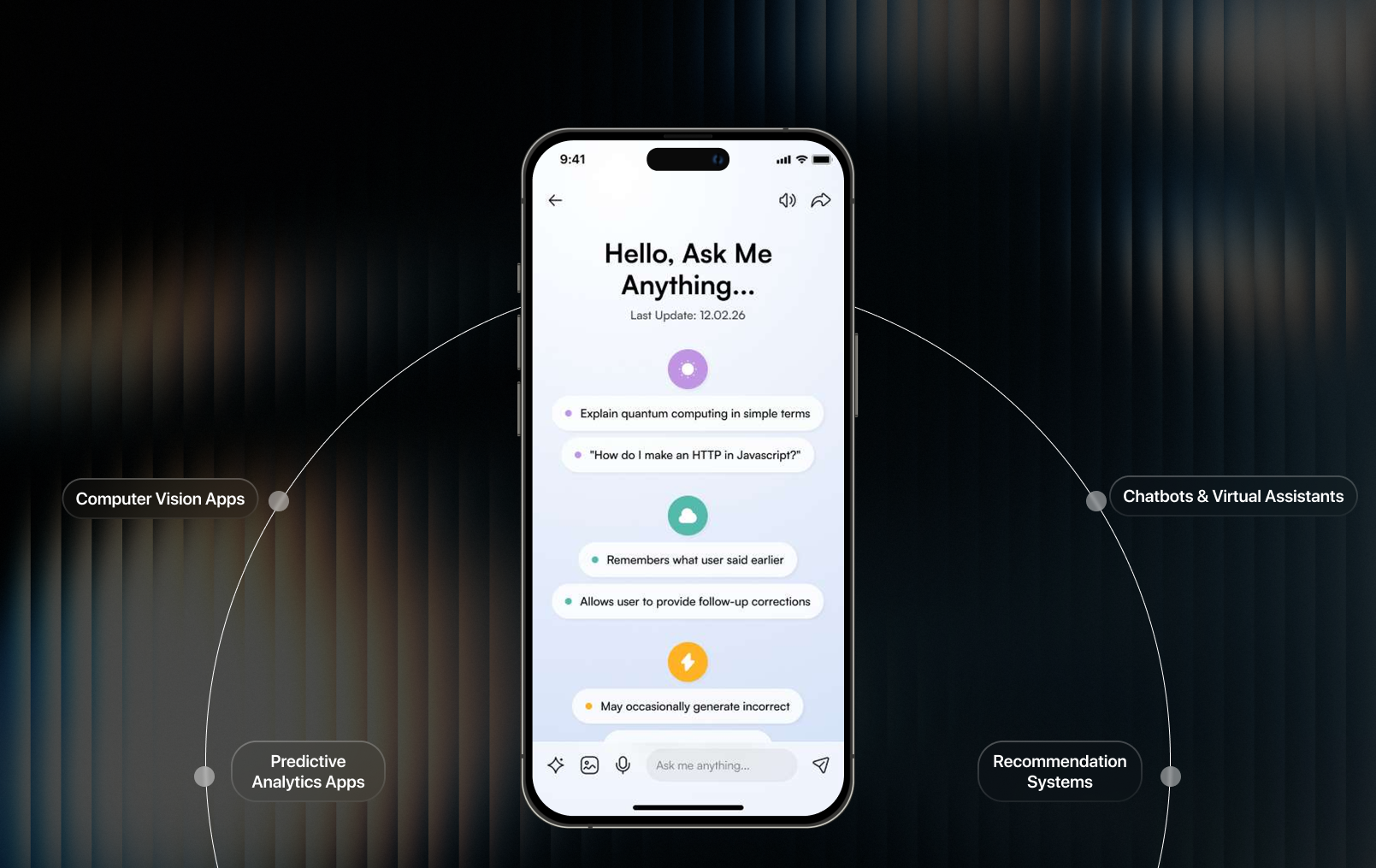
Artificial intelligence is no longer a futuristic concept. By 2026, it will have become the backbone of modern software. Businesses across the globe are heavily investing in AI apps to streamline operations, enhance customer experiences, and unlock entirely new revenue streams.
Whether you run a nimble startup or manage a large enterprise, integrating artificial intelligence app development into your business strategy is essential for staying competitive. Traditional software is reactive, but AI software development creates proactive, intelligent systems that learn, adapt, and predict user needs.
This comprehensive guide will explore how to build AI app solutions that deliver real ROI. We will break down the process, outline the core technologies, and explain exactly how much you can expect to spend.
What is AI App Development?
AI app development is the process of building software applications that use machine learning, natural language processing, or computer vision to perform tasks that typically require human intelligence. These applications analyze large amounts of data, recognize patterns, and make autonomous decisions.
Unlike traditional applications that follow rigid, rule-based programming, AI applications learn from user interactions. They get smarter and more accurate over time. This dynamic capability makes them incredibly valuable for modern businesses.
Examples of AI Applications
To understand the impact of AI, you can look at the software you already use daily. Common examples include:
Chatbots: Intelligent conversational agents that handle complex customer service queries 24/7 without human intervention.
Recommendation Systems: Algorithms used by streaming platforms and e-commerce stores to suggest content or products based on past user behavior.
Automation Apps: Tools that automatically categorize data, process invoices, or schedule logistics based on predictive analytics.
Visual Suggestion: A conceptual AI architecture diagram showing how user input flows through a machine learning model to generate a smart output.
Types of AI Applications
The field of machine learning app development is vast. Startups and enterprises usually focus on a few core types of AI applications, depending on the specific problem they want to solve.
Chatbots & Virtual Assistants
Modern chatbots do much more than answer basic FAQs. Powered by large language models, they can troubleshoot technical issues, process orders, and provide personalized financial advice. They understand context, sentiment, and intent.
Recommendation Systems
E-commerce and media companies rely heavily on recommendation systems. By analyzing massive datasets of user behavior, these AI apps predict what a user will want to watch or buy next. This directly increases engagement and sales.
Computer Vision Apps
Computer vision enables software to "see" and interpret visual data from the real world. You see this technology in medical imaging software that detects anomalies in X-rays, or in retail apps that allow users to search for products using a smartphone photo.
Predictive Analytics Apps
Predictive analytics applications forecast future outcomes based on historical data. Supply chain managers use these apps to predict inventory shortages. Financial institutions use them to detect fraudulent transactions before they happen.
Visual Suggestion: A sleek chatbot UI mockup displaying an intelligent conversation with a user.
AI App Development Process (Step-by-Step)
Building an intelligent application requires a different approach than standard software. Partnering with an experienced mobile app development company ensures you navigate these steps smoothly. Here is the standard AI app development process.
Step 1: Problem Definition
Before writing a single line of code, you must define the problem. What specific business challenge are you trying to solve? Determining whether you need an AI solution or a traditional software fix is crucial. This step also involves defining your target audience and core features. If you are launching a new product, you might want to read our guide on how to build an MVP for a startup.
Step 2: Data Collection
AI models run on data. You need high-quality, relevant data to train your application. This phase involves gathering structured and unstructured data from internal databases, APIs, or third-party providers. The cleaner the data, the more accurate the AI will be.
Step 3: Model Selection
Next, data scientists choose the appropriate machine learning model for their specific use case. A recommendation engine requires a different model than a generative AI text tool. Sometimes, developers use pre-trained models (like OpenAI's GPT) to save time, while other projects require custom algorithms.
Step 4: Training
During training, developers feed the collected data into the selected model. The system learns to identify patterns and make predictions. This phase is highly iterative. Engineers constantly tweak parameters and test the model until it achieves an acceptable level of accuracy.
Step 5: Integration
Once the AI model is trained and optimized, it must be connected to the application's backend and frontend. This is where AI SaaS development meets traditional software engineering. The AI must communicate seamlessly with user interfaces and external databases.
Step 6: Testing
Testing AI applications is complex because their outputs are not strictly deterministic. QA teams must test the application for accuracy, performance under heavy loads, and potential biases. They ensure the AI behaves correctly across various edge cases.
Step 7: Deployment
After rigorous testing, the app is deployed to the cloud or local servers. However, AI app development does not end at launch. The model must be continuously monitored and updated with new data to prevent "model drift," ensuring it remains accurate over time.
AI Development Timeline Table
Development Phase | Average Duration | Key Deliverables |
Discovery & Problem Definition | 2–4 Weeks | Project scope, feature list, MVP strategy |
Data Collection & Preparation | 3–6 Weeks | Cleaned datasets, data pipelines |
Model Selection & Training | 6–12 Weeks | Trained a machine learning model, and accuracy reports |
UI/UX & Backend Integration | 4–8 Weeks | Frontend design, API integration, functional app |
QA Testing & Refinement | 3–5 Weeks | Bug fixes, performance optimization, bias testing |
Deployment & Monitoring | 1–2 Weeks (Ongoing) | Live application, continuous feedback loops |
Visual Suggestion: A step-by-step machine learning workflow graphic.
AI App Development Cost in 2026
Budgeting for an AI project requires understanding that costs vary wildly based on complexity, data requirements, and the specific tech stack. Here are the average costs for AI software development in 2026:
Basic AI App ($30K – $80K): These applications generally rely on existing, pre-trained AI models integrated via APIs. Examples include basic customer service chatbots or simple text-generation tools.
Mid-Level AI App ($80K – $200K): These apps require fine-tuning existing models with custom data. They often involve custom backend architecture and moderate data engineering. Examples include custom recommendation engines or predictive inventory systems.
Advanced AI App ($200K – $500K+): Enterprise-grade solutions built from scratch. These require massive data collection, custom algorithmic design, and extensive cloud infrastructure. Examples include proprietary computer vision software or autonomous financial trading bots.
If you are looking for a broader perspective on mobile development expenses, check out our complete breakdown on the cost to build a mobile app. Furthermore, if your application is subscription-based, you should also factor in the overall SaaS development cost.
AI App Development Cost Breakdown
To give you a clearer picture of where your budget goes, here is a detailed breakdown of the different phases of custom software development for AI.

AI Tech Stack for App Development
Choosing the right technology stack is critical for the performance and scalability of your application. An experienced software development company will typically utilize a combination of the following tools:
Programming Languages and Frameworks
Python remains the undisputed king of AI development due to its rich ecosystem of libraries. Developers rely heavily on frameworks like TensorFlow and PyTorch to build and train complex neural networks efficiently.
AI APIs
Not every project requires a model built from scratch. Developers often use powerful APIs to integrate advanced AI capabilities quickly. Utilizing OpenAI's APIs for natural language processing or Google Vision API for image recognition can significantly reduce development time and costs.
Cloud Infrastructure
Training and running AI models require massive computational power. Cloud platforms like AWS (Amazon Web Services), Microsoft Azure, and Google Cloud Platform (GCP) provide scalable GPU resources, machine learning pipelines, and secure hosting environments necessary for AI applications.
AI Use Cases by Industry
Artificial intelligence is transforming every major sector. Here is how different industries are applying AI software development.
Fintech
Financial institutions use AI for fraud detection, algorithmic trading, and personalized wealth management. Predictive analytics can analyze spending habits to offer tailored financial products to consumers in real-time.
Healthcare
AI is revolutionizing patient care. Computer vision apps assist radiologists in identifying tumors with higher accuracy. Additionally, AI-driven scheduling applications optimize hospital operations, while virtual assistants triage patient symptoms remotely.
E-commerce
Online retailers leverage AI to maximize conversions. Recommendation engines show users products they are highly likely to buy. AI also powers dynamic pricing models, adjusting prices in real-time based on demand, inventory levels, and competitor pricing.
OTT Platforms
AI is transforming industries such as fintech, healthcare, e-commerce, and OTT platform development. In OTT platform development, AI plays a crucial role in delivering personalized user experiences through recommendation systems, content categorization, and user behavior analysis. Streaming platforms use AI to suggest relevant content, improve engagement, and increase watch time. Businesses looking to build advanced video streaming solutions often integrate AI-driven features into their OTT platform development strategy.
Artificial intelligence is transforming every major sector. Here is how different industries are applying AI software development. AI algorithms analyze viewing histories to suggest the next show. Furthermore, AI is used to optimize video streaming quality in real-time based on the user's internet connection.
AI Use Case Comparison Table
Industry | Core AI Application | Business Value |
Fintech | Fraud Detection | Reduces financial losses and improves security compliance. |
Healthcare | Medical Image Analysis | Increases diagnostic accuracy and speeds up patient care. |
E-commerce | Recommendation Systems | Boosts average order value and customer retention. |
OTT Platforms | Content Personalization | Increases viewer watch time and reduces subscriber churn. |
Visual Suggestion: A modern AI analytics dashboard showing real-time data visualizations.
Challenges in AI App Development
While the benefits are massive, building AI applications comes with distinct challenges.
First, data privacy is a major concern. Applications must comply with strict regulations like GDPR or HIPAA, ensuring user data is secure and anonymized. Second, there is the challenge of "hallucinations" or algorithmic bias, where AI models output incorrect or biased information based on flawed training data.
Finally, computing costs can spiral out of control if cloud infrastructure is not optimized. Continuous model training requires significant server resources. Partnering with professional AI development services is the best way to mitigate these risks and build a secure, cost-effective product.
Future Trends in AI Applications
As we look beyond 2026, AI applications will become even more autonomous. Edge AI is a rapidly growing trend in which AI processing happens directly on the user's mobile device rather than in the cloud. This reduces latency and improves privacy.
We will also see a rise in multi-modal AI systems capable of seamlessly understanding and generating text, images, video, and audio simultaneously. This will lead to hyper-personalized, immersive app experiences that blur the line between software and human-like interaction.
Conclusion
Artificial intelligence app development is no longer optional for businesses aiming to lead their respective markets in 2026. The ability to automate complex tasks, predict user behavior, and provide personalized experiences offers unmatched business value and future scalability.
Whether you are looking to build a conversational chatbot, an intelligent e-commerce recommendation system, or a custom computer vision tool, understanding the costs, processes, and tech stack is your first step to success.
Are you ready to turn your AI vision into a reality?
Contact iCode49 Technolabs today. We specialize in custom AI solutions, full-scale AI app development, and seamless SaaS + AI integrations designed to scale your business. Reach out to our expert team to discuss your project.
 Ahmedabad, INDIA
 1214, Rashmi Prime, Besides STC Building, Vakil Saheb Bridge, Ambli, Ahmedabad, Gujarat – 380058
 USA
USA Dubai, UAE
 Singapore
 WhatsApp
 Gmail
Gmail Contact no


