



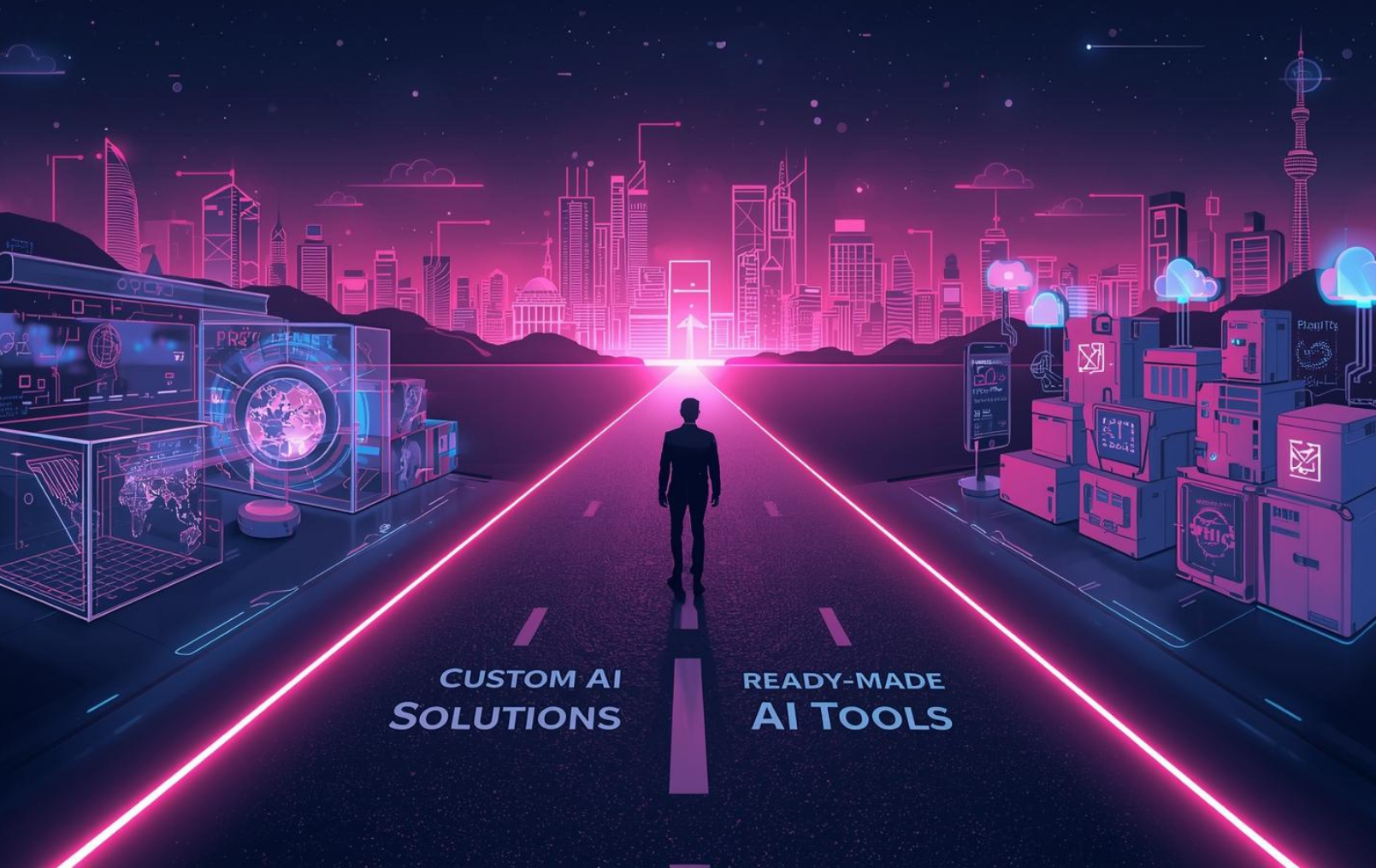
Artificial Intelligence has become a core driver of innovation across industries like healthcare, finance, manufacturing, retail, and logistics. Companies of all sizes are now exploring AI to improve efficiency, deliver personalized experiences, and gain a competitive edge.
However, there is a crucial decision every business must make before implementing AI. Should you build a custom AI solution tailored to your unique needs, or adopt ready-made AI tools that are quick to deploy?
Choosing the right approach can influence everything from initial costs to long-term scalability. A mismatch here often results in wasted resources, unmet expectations, or even operational risks.
This blog will walk you through the differences between these two options. You will learn how to weigh factors like cost, control, flexibility, and time-to-market to find the best fit for your organization. By the end, you will have a clear understanding of whether custom AI solutions or off-the-shelf AI tools are the right choice for your business.
Understanding the Two Options
Before diving into the pros, cons, and decision-making factors, it is important to understand what each option really means. Many businesses confuse the two or assume they are interchangeable, which can lead to poor decisions later.
What Are Custom AI Solutions?
Custom AI solutions are systems built specifically for your business, designed to address unique workflows, data sets, and operational needs. These solutions are developed in close collaboration with an AI development company to ensure they align perfectly with your goals.
Examples of custom AI solutions across industries:
- Retail: Personalized product recommendations using proprietary customer data.
- Healthcare: AI-powered diagnostic tools trained on specialized patient records.
- Manufacturing: Predictive maintenance systems tailored to unique machinery and processes.
- Finance: Fraud detection models customized to a bank’s transaction patterns.
Why businesses consider custom AI solutions:
- Full ownership and control of the system.
- Ability to integrate seamlessly with existing processes.
- Competitive edge by creating something competitors cannot easily replicate.
When a company invests in custom AI solutions development, it essentially builds technology that is as unique as its business model. This often involves stages like strategy planning, design, development, testing, and ongoing improvements.
What Are Ready-Made AI Tools?
Ready-made AI tools, also known as off-the-shelf AI tools, are pre-built software solutions created to solve common business challenges. These tools are designed for quick deployment and are often sold as subscription-based products.
Examples of ready-made AI tools:
- Chatbots for customer support.
- AI-driven email marketing automation platforms.
- Predictive analytics dashboards for sales teams.
- Voice-to-text transcription services.
Why businesses choose ready-made tools:
- Faster implementation with minimal setup.
- Lower initial costs compared to building a custom system.
- Access to regular updates and vendor support.
However, these benefits come with trade-offs. Since ready-made tools are built for a broad audience, they may lack deep customization and can create long-term dependency on the vendor.
Key Factors to Consider Before Choosing
Selecting the right AI approach goes beyond personal preference. It involves carefully weighing several factors that directly impact your business’s performance and long-term strategy. Below are the most important areas to analyze before making a decision.
Cost Comparison
Cost is often the first consideration for any business looking to adopt AI. However, it is important to go beyond the upfront investment and understand the total cost of ownership.
Custom AI Solutions:
- Require higher initial investment for design, development, and testing.
- May include costs for specialized talent, infrastructure, and ongoing updates.
- Can generate long-term savings by eliminating licensing fees and reducing dependency on external vendors.
Ready-Made AI Tools:
- Typically have lower upfront costs since they are subscription-based or license-based.
- Offer predictable monthly or yearly expenses.
- May lead to higher cumulative costs over time, especially if scaling up requires multiple licenses or add-ons.
| Factor |
Custom AI Solution |
Ready-Made AI Tool |
| Initial Cost |
High, one-time build expense |
Low, subscription-based |
| Maintenance |
In-house or partner-managed |
Handled by the vendor |
| Scalability |
Fully customizable, flexible |
Limited to vendor's roadmap |
| Total Ownership |
Long-term savings potential |
May increase with scaling |
Flexibility and Control
AI is most effective when it reflects the unique processes of your business.
Flexibility and control determine how well the technology adapts to your changing needs.
With custom AI solutions:
- You control every feature and function.
- The system grows alongside your strategy and growth.
- Proprietary data remains private and secure.
With ready-made AI tools:
- You are limited to the vendor’s features and updates.
- Some workflows may require workarounds or manual adjustments.
- Data handling may not be fully customizable, creating compliance concerns.
Speed of Deployment
Time-to-market plays a vital role, especially for fast-moving industries like retail or tech startups.
- Ready-made AI tools can be implemented within days or weeks, allowing businesses to see results quickly.
- Custom AI solutions take longer to develop but ensure the final product fits your business perfectly.
If speed is a priority and the need is urgent, ready-made solutions may be a better short-term choice.
If precision and alignment are more important, a custom build offers greater long-term value.
Security and Compliance
Data privacy and compliance are non-negotiable, especially for industries handling sensitive information like healthcare, finance, or government services.
- Custom AI solutions allow businesses to implement security measures tailored to their policies.
- Ready-made AI tools may share infrastructure across multiple clients, which can limit the level of control over data storage and processing.
When compliance regulations like GDPR or HIPAA are involved, custom AI often provides a safer route.
Pros and Cons of Each Approach
Both custom AI solutions and ready-made AI tools have their advantages and disadvantages. The right choice depends on your company’s priorities, resources, and long-term vision. Here is a closer look at the pros and cons of each option.
Pros and Cons of Custom AI Solutions
Pros of Custom AI Solutions:
- Tailored fit for your business: Built specifically to match your processes and challenges.
- Competitive advantage: Unique features that competitors cannot easily replicate.
- High flexibility: Add or remove functionalities as your business evolves.
- Complete data ownership: Control how data is collected, stored, and analyzed.
- Seamless integration: Easily connects with other internal systems or third-party tools.
Cons of Custom AI Solutions:
- Higher upfront cost: Significant investment needed for design and development.
- Longer timeline: Takes time to plan, build, and test thoroughly before launch.
- Specialized talent required: May need internal expertise or external partners for ongoing updates.
Pros and Cons of Ready-Made AI Tools
Pros of Ready-Made AI Tools:
- Quick implementation: Can be deployed in days or weeks, ideal for urgent needs.
- Lower initial costs: Minimal setup expenses, often subscription-based
- Regular vendor updates: Continuous improvements managed by the provider.
- User-friendly interfaces: Designed to work for a wide audience with minimal training.
Cons of Ready-Made AI Tools:
- Limited customization: Features are fixed and may not fully align with your workflows.
- Scalability challenges: Growth depends on the vendor’s roadmap, not your strategy.
- Data privacy concerns: Sensitive information is handled on shared infrastructure.
- Vendor lock-in: Switching providers can be expensive and time-consuming.
When to Choose Custom AI Solutions vs Ready-Made Tools
There is no single answer to whether a business should invest in a custom AI solution or go with a ready-made tool. The decision depends on your business model, available resources, industry requirements, and future growth plans. Below are clear scenarios to help you understand which approach makes the most sense for your situation.
When Custom AI Is the Better Choice
Custom AI solutions work best for businesses that need a high level of control, scalability, and unique features. These solutions align perfectly with companies that view AI as a long-term competitive advantage rather than just a short-term tool.
Choose custom AI solutions if:
- You have complex workflows that cannot be managed by generic software.
- Your industry requires strict compliance and data security measures.
- You want to own the intellectual property and keep your data completely private.
- You need advanced integrations with existing in-house systems.
- Your company plans to scale rapidly and evolve its AI capabilities over time.
Examples:
- A healthcare provider creating a predictive model for patient diagnostics.
- A bank building a fraud detection system unique to its customer data.
- A retail brand developing a fully customized recommendation engine.
When Ready-Made AI Tools Make Sense
Ready-made AI tools are ideal for companies that want quick results without heavy upfront investment. These solutions are built for standard processes and can help you get started with AI while minimizing risk.
Choose ready-made AI tools if:
- You need to implement AI quickly with minimal setup.
- Your workflows are common across the industry, such as CRM or HR processes.
- You have a limited budget or are experimenting with AI for the first time.
- The tool is not central to your competitive strategy and can function as a supporting system.
- You prefer to rely on a vendor for maintenance and regular updates.
Examples:
- A small e-commerce store using an AI chatbot for customer support.
- A mid-sized business adopting AI-powered email marketing automation.
- A logistics company deploying a ready-made route optimization tool.
Quick Decision Checklist
Here’s a simple checklist you can use to determine which approach fits best. If you answer “yes” to most questions in either column, that is the direction to consider.
| Question |
Custom AI Solution |
Ready-Made AI Tool |
| Do you need complete control over features? |
Yes | No |
| Is speed of implementation a top priority? |
No | Yes |
| Is data privacy a major concern? |
Yes | No |
| Is this core to your competitive strategy? |
Yes | No |
| Is your budget limited or fixed? |
No | Yes |
| Do you require deep integration with other systems? |
Yes | No |
This structured comparison helps you make an informed decision without guesswork.
Practical Decision-Making Framework
Making the right choice between a custom AI solution and a ready-made AI tool can feel overwhelming. Instead of guessing, businesses can follow a structured approach to weigh their options and reach a clear decision. Here is a practical framework that simplifies the process into four actionable steps.
Step 1: Define Your AI Goals
Before you start comparing solutions, clarify why you need AI and what you hope to achieve.
Questions to ask:
- What specific problem are we trying to solve?
- Is this AI project central to our long-term strategy or a supporting tool?
- How will success be measured: revenue growth, cost reduction, or improved customer experience?
Outcome:
A clear understanding of your goals will make it easier to match the right AI approach to your needs.
Step 2: Evaluate Internal Resources
Assess your team’s capabilities and infrastructure to determine how much you can handle internally.
Consider these factors:
- Do you have in-house technical expertise to maintain a custom AI solution?
- Is your team equipped to manage data privacy and compliance?
- Can your current infrastructure support large-scale AI deployments?
If you lack these resources, a ready-made AI tool might be a safer starting point.
Step 3: Analyze Costs and Timelines
Use a realistic view of both short-term and long-term expenses when comparing custom AI vs off-the-shelf AI cost.
Custom AI Solutions:
- Higher initial investment but potential for long-term savings.
- Customizable to match business growth without external licensing fees.
Ready-Made AI Tools:
- Lower upfront costs but recurring subscription fees.
- Vendor-controlled upgrades that may affect future budgets.
Pro Tip:
Create a simple cost projection for 3-5 years to see which option makes more financial sense.
Step 4: Match Features to Future Needs
Think beyond your current requirements. AI is a long-term investment, and your needs will evolve as your business grows.
Questions to guide this step:
- Will the chosen solution scale as our business expands?
- Can we add or modify features without rebuilding from scratch?
- How dependent will we be on a vendor’s roadmap?
Decision Tip:
If you need full control over features and scalability, custom AI solutions are usually the better choice.
Decision-Making Flow
| Question |
If Yes → |
If No → |
| Is AI core to your competitive strategy? |
Consider Custom AI Solution |
Consider Ready-Made AI Tool |
| Do you need complete data ownership? |
Custom AI Solution |
Ready-Made AI Tool |
| Is speed of deployment critical? |
Ready-Made AI Tool |
Custom AI Solution |
| Is budget limited or fixed? |
Ready-Made AI Tool |
Custom AI Solution |
Role of an AI Development Company
Choosing between a custom AI solution and a ready-made AI tool is only the first step. The real challenge lies in implementing the decision effectively and ensuring it aligns with your business goals.
At iCode49, we help you:
- Understand whether to build or buy based on your unique needs.
- Plan costs and timelines with clarity.
- Develop and integrate custom AI solutions that grow with your business.
- Optimize ready-made tools for smoother adoption and better results.
By combining technical expertise with a business-first approach, we make AI implementation simpler, faster, and more reliable.
Conclusion
The decision between a custom AI solution and a ready-made AI tool depends on your business goals, resources, and growth plans.
If you need quick implementation and lower upfront costs, ready-made tools can get you started fast.
If you want full control, scalability, and a long-term competitive edge, a custom AI solution is the smarter choice.
At iCode49 Technolabs, we help you make this decision with confidence and implement AI in a way that drives real results. Connect with us today!
 Ahmedabad, INDIA
 1214, Rashmi Prime, Besides STC Building, Vakil Saheb Bridge, Ambli, Ahmedabad, Gujarat – 380058
 USA
USA Dubai, UAE
 Singapore
 WhatsApp
 Gmail
Gmail Contact no


