



Companies outsource product development when building everything in-house would slow the product down, require skills they cannot hire quickly, or create more permanent engineering overhead than the business needs. An external product development team can provide specialized expertise, faster execution, flexible development capacity, and an experienced product team without requiring the company to build that capability from scratch.
But outsourcing isn't automatically the better choice, and cost alone is a poor reason to do it. The real decision is whether an externalproduct development company can help you reach your product goals faster and more efficiently. At the same time, you retain ownership, quality, technical visibility, and control over important product decisions.
Which Countries Are Best for Outsourced Product Development?
No single country is best for outsourced product development. The practical comparison comes down to talent availability, outsourcing maturity, development cost, technical capability, and time-zone fit.
India — Best overall for scale and cost:
India's technology workforce is projected to reach 5.95 million in FY26, while NASSCOM expects the sector to generate $315 billion in revenue. For buyers, that means a deep pool of software, cloud, AI, and engineering talent. Clutch's 2026 data puts Indian custom software development companies typically at $25–$49/hour.
Poland — Best for European engineering talent:
Poland's 2025 IT/ICT report from PARPidentifies more than 100,000 ICT entities and describes strengths in AI, cloud, IoT, and cybersecurity, with IT/ICT exports reaching demanding markets including the US, Germany, and the UK. Clutch currently places Polish software development companies at $50–$99/hour.
Philippines — Best for mature outsourcing and English-language delivery:
The country's IT-BPM sector employed about 1.9 million people in 2025 and generated more than $40 billion in revenue, according to IBPAP figures reported in January 2026. The OECD also describes IT and software as an increasingly important higher-value segment of the country's BPO industry. Clutch lists typical software development company rates at $25–$49/hour.
Mexico — Best for US nearshore development:
Mexico had approximately 390,000 software developers and multimedia analysts in Q1 2026, according to Mexico's government Data México, with an average monthly salary of about MXN 11,000. Its biggest outsourcing advantage is proximity to US working hours; a 2026 study of outsourced software teams also found nearshore delivery advantageous for communication, quality, schedule, and project-management effort. Clutch lists Mexican software development companies at $25–$49/hour.
The practical choice:
India is usually strongest when you need scale, broad technical skills, and lower provider rates.
Poland fits companies prioritizing European engineering depth and proximity.
The Philippines is attractive for mature outsourcing and English language delivery.
While Mexico is compelling for US companies that value same-day collaboration and nearshore access.
These price ranges are useful for initial comparison, not for estimating your final project cost. A senior product team, AI specialists, or an end-to-end product engineering engagement can cost considerably more than the country's general provider range.
Why Are Companies Outsourcing Product Development?
Companies rarely outsource product development simply because an external team is cheaper. More often, they have a business constraint that internal hiring cannot solve quickly enough: a critical skill is missing, the product deadline is approaching, or the existing engineering team is already stretched.
Deloitte's Global Outsourcing Survey supports this shift. 80% of surveyed executives said they planned to maintain or increase investment in third-party outsourcing, while skilled talent and agility have become important drivers alongside cost reduction.
1. They need to launch faster
Building an internal team takes time—recruitment, interviews, notice periods, onboarding, and product ramp-up all happen before meaningful development can begin.
An established product development partner can bring an existing team of developers, designers, QA engineers, and technical leadership into the project.
The benefit isn't simply faster coding. It's faster access to the capability required to build.
2. They need skills they don't have
A modern product may require AI, cloud architecture, cybersecurity, DevOps, data engineering, or mobile expertise.
You may need those skills for one product phase without needing every specialist permanently.
Outsourcing lets companies access specialized capabilities without building an entire internal department around them.
3. They need a complete product team
Five developers don't automatically make a product team.
A production-ready product may also need product management, UX/UI, architecture, QA, and DevOps.
For startups and companies entering a new product category, an experienced external team can provide these capabilities together rather than requiring the company to recruit every role separately.
4. They need flexibility
Product workloads change.
A company may need a larger team during an MVP build or major platform migration, then significantly fewer engineers after launch.
Outsourcing makes it easier to adjust development capacity without permanently increasing headcount.
This is particularly useful for MVP development, product launches, legacy modernization, and specialized technology projects.
5. They want internal teams focused on strategic work
Outsourcing doesn't have to mean outsourcing everything.
An internal team can retain product strategy, customer knowledge, and core architecture while an external team handles feature development, QA automation, cloud migration, or specialized engineering.
This hybrid model lets internal engineers spend more time on decisions that directly differentiate the product.
6. They want another experienced perspective
This is one of the less obvious benefits.
A good product development partner can challenge assumptions before they become expensive problems:
“Does this feature really belong in version one?”
“Do you need to build this yourself?”
“Will this architecture scale?”
That outside perspective can prevent unnecessary development and rework.
The real reason
The strongest reason to outsource product development is not simply lower cost. It's gaining a capability faster, more flexibly,y or with less organizational friction than building it internally.
If hiring is already easy, your team has the required expertise, and the product needs constant internal collaboration, outsourcing may add little value.
But when speed, specialized skills, capacity, or product expertise are the constraints, the right external team can become an extension of the organization—not just a source of developers.
What Does Outsourced Product Development Cost?
There is no fixed price for outsourced product development. Your cost depends on the product's complexity, team composition, location, timeline, and technical requirements.
A useful starting benchmark is the current pricing data for software development companies on Clutch:

These are software development company rates, not developer salaries. Use them to compare markets, not as a final project quote.Clutch Software Development Pricing Guide
What actually drives your project cost?
The hourly rate is only one part of the calculation.
Product complexity:
An MVP is very different from an AI platform, fintech product, or enterprise SaaS.
Team composition:
A team of senior engineers, architects, and specialists will cost more than a junior-heavy team.
Scope:
More features, integrations, and platforms mean more development hours.
Timeline:
An accelerated launch may require additional engineers or parallel workstreams.
Specialized requirements:
AI, cybersecurity, cloud architecture, data engineering, and regulatory compliance can increase the cost.
Post-launch work:
Maintenance, monitoring, security updates, and new features create ongoing costs after the initial launch.
Where a “cheaper” vendor can become expensive
The lowest quote can lose its advantage quickly when the delivery process creates additional work.
Unclear requirements
can lead to features being built differently from what you intended, followed by expensive rework.
Poor communication or time-zone gaps
can slow decisions. When a simple clarification takes a full working cycle to resolve, small delays accumulate across a project.
Weak documentation and knowledge transfer
can create another hidden cost. You may receive working software but struggle to maintain it when the vendor leaves, or you move development in-house.
Poor IP and ownership terms
can create an even bigger problem. Before development starts, make sure your contract clearly covers source-code ownership, intellectual property, repositories, documentation, credentials, and access to project assets.
The cheapest hourly rate is therefore not necessarily the cheapest way to build the product.
Which pricing model should you choose?
The right commercial model depends on how clearly you understand the product.

A common mistake is choosing fixed price for an undefined product because it feels financially safer. In practice, every change can become a change request, negotiation, or additional charge.
If the requirements are still evolving, time and materials often provides more flexibility. If you have a stable specification, fixed price can provide better budget predictability.
Should you outsource everything?
Not necessarily.
There is another option between building everything internally and commissioning a fully custom product: white-label or pre-built platforms.
They can make sense for functionality that customers expect, but that does not differentiate your business—for example, standard payments, basic logistics, loyalty features, or other infrastructure.
If the functionality is your competitive advantage, however, a pre-built platform can become restrictive. You may end up adapting your business to the platform instead of the platform supporting your business.
The trade-off is straightforward:
Custom development gives you control and differentiation.
Pre-built solutions give you speed and lower upfront development effort.
Don't compare an outsourcing rate with an employee's salary
A full-time employee has costs beyond salary, including recruitment, benefits, equipment, management, and onboarding. An outsourcing quote may already include some combination of engineering management, QA, project management, and other delivery costs.
So the better question isn't:
“Who has the lowest hourly rate?”
Ask:
“What am I getting for that rate, and what will it cost to reach the product outcome I need?”
A $35/hour team that needs 5,000 hours costs $175,000. A $50/hour team that completes the same scope in 3,000 hours costs $150,000.
The right comparison is total cost to deliver—not the cheapest developer rate.
How Does Product Development Outsourcing Actually Work?
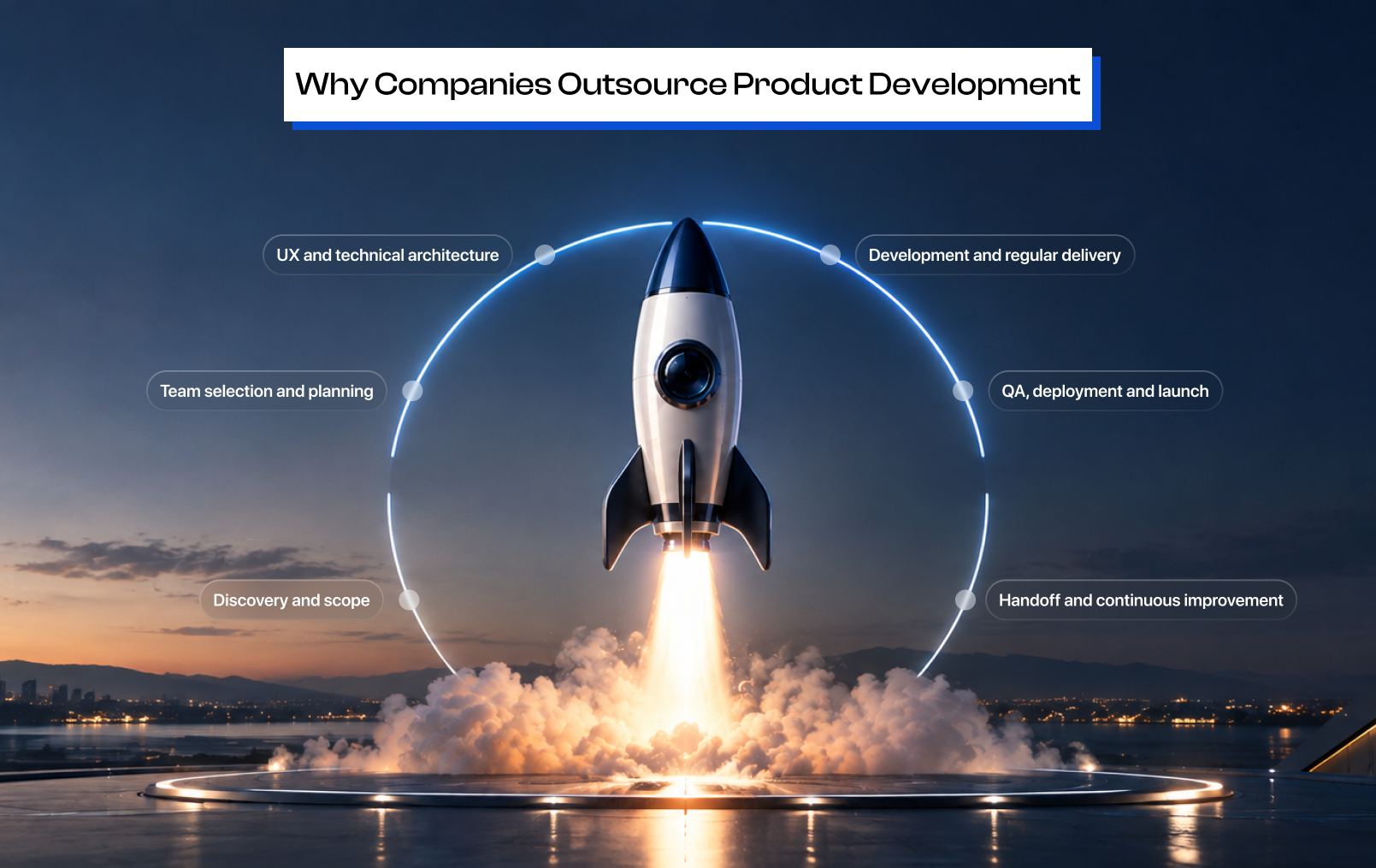
Product development outsourcing usually follows a structured process from discovery to post-launch support. The client remains responsible for product direction and business decisions, while the external team handles the agreed design, engineering, and delivery work.
1. Discovery and scope
The process starts by understanding the business model, target users, product goals, existing technology, and technical constraints. An experienced partner should also challenge assumptions and separate must-have features from ideas that can wait. The purpose is not to produce a huge requirements document; it is to remove ambiguity before development creates expensive rework.
2. Team selection and planning
Before development begins, confirm who will actually work on the product, their responsibilities, and relevant experience. The agreement should also define the scope, deliverables, payment model, change-request process, IP ownership, security requirements, and exit terms. Meeting the delivery team—not just the sales representative—can reveal whether the proposed team matches what was promised.
3. UX and technical architecture
The team translates requirements into user flows, wireframes, UI designs, and a technical architecture covering the technology stack, database, APIs, authentication, infrastructure, and third-party services. The objective isn't to engineer for every possible future scenario; it is to create a foundation that supports the expected product roadmap without unnecessary complexity.
4. Development and regular delivery
Development typically happens in sprints or short iterations, with working software demonstrated throughout the project. Instead of measuring progress by the number of tickets closed, look for usable outcomes—for example, whether users can register, complete onboarding, or make a transaction. Regular demonstrations also expose scope misunderstandings while they are still relatively inexpensive to fix.
5. QA, deployment and launch
Quality assurance should run alongside development rather than being left until the final week. Depending on the product, testing may cover functionality, APIs, regression, performance, security, browsers and devices. Before launch, the team also prepares production infrastructure, monitoring, analytics, error tracking, backups and, where applicable, App Store or Google Play submissions.
6. Handoff and continuous improvement
A proper handoff should include source code, documentation, credentials, infrastructure access, and knowledge transfer so the business is not dependent on one person or vendor to operate its product. After launch, real users provide evidence that should shape the next release through product usage, conversion, retention, errors, and customer feedback.
Who owns what?
A healthy outsourcing relationship keeps responsibilities clear:
The client owns the product vision, business priorities, and key decisions.
The development partner owns the agreed technical execution and delivery.
This distinction matters because an external team can build what you define, but it cannot replace the business knowledge required to decide what should be built in the first place.
What Can Go Wrong When You Outsource Product Development?
Outsourcing can work extremely well, but the risks are real. In my experience, the biggest problems usually come from unclear requirements, poor ownership, weak communication, and vendor dependency, rather than from coding ability alone.
The cheapest quote can become the most expensive one.
A $60,000 proposal isn't necessarily cheaper than a $100,000 proposal if the first vendor underestimates the scope, causes rework, or charges heavily for changes. Compare vendors on the total cost of achieving the required outcome, not just the initial quote.
Unclear requirements create expensive rework.
If the client says, “Build something like Uber,” the development team still needs answers about users, geography, payments, matching, cancellations, and the MVP scope. Good discovery reduces these assumptions before development begins.
Slow client decisions can delay the project.
An external team can be ready to work while waiting for design approvals, API credentials, business rules, or requirement decisions. Someone on the client side should have clear product decision authority and respond quickly enough to keep development moving.
Communication problems compound over time.
A small misunderstanding in week one can become significant rework in month three. Written requirements, recorded decisions, regular demos, and one shared source of truth help prevent information from being lost across meetings, email and chat.
One developer shouldn't become a single point of failure
If only one person understands the architecture, deployment process or critical business logic, their departure can put the product at risk. Documentation, code reviews, shared repositories and knowledge transfer make the product transferable between people and teams.
Vendor lock-in can reduce your control
Your company should retain appropriate ownership and access to the source code, repository, cloud accounts, database, domain, design files and documentation. A vendor can manage these assets without becoming the only party capable of accessing or understanding them.
IP and data protection need to be contractual.
Don't rely on verbal promises about ownership or security. Contracts should clearly address IP assignment, confidentiality, source-code ownership, and data access, while regulated products may require additional security and compliance controls.
Red flags worth taking seriously
Be cautious when a vendor quotes before understanding the product, promises an unrealistic timeline, cannot explain its QA process, avoids IP discussions, refuses appropriate repository access, or shows impressive designs without demonstrating real shipped products.
An experienced partner should also be willing to tell you what not to build.
The goal isn't zero risk
No outsourcing model removes every risk. The objective is to make risks visible and manageable: clear scope, clear ownership, transparent progress, documented code, and a defined exit path.
That is what turns outsourcing from a vendor transaction into a workable product-development partnership.
When outsourcing makes sense vs. when it doesn't
In-house wins when:
the work is core to your long-term competitive advantage, you need people embedded in company culture and context daily, or you have the runway and certainty to build a stable team around a well-defined, long-term roadmap.
Outsourcing wins when:
you need a skill set you can't hire locally in your timeline, the work is well-scoped and time-bound, or you're validating a product direction and don't yet know if it warrants a permanent team.
Hybrid wins when:
you want a small in-house core team owning product vision and architecture, with an outsourced or dedicated team extending execution capacity — this is, in practice, the most common setup for companies past the earliest startup stage, and often the most durable one.
A simple gut check:
If you'd still want this function to exist, unchanged, in your company five years from now regardless of who's on the team, lean in-house. If the need is real but the shape of it is likely to change significantly within 12–18 months, outsourcing or hybrid gives you the flexibility that in-house hiring can't.
Why India Is a Major Outsourcing Destination
India's appeal for product development outsourcing goes beyond lower development rates. Its bigger advantage is the scale of its technology ecosystem.
NASSCOM estimated India's technology industry at about $283 billion in FY25, with around 5.8 million professionals across software, IT services and related technology roles. That creates a broad talent pool covering software engineering, cloud, AI, cybersecurity, QA, architecture and product development.
For international companies, this scale provides another advantage: choice. You can find teams for a narrowly defined project, a specialist technology requirement, or a long-term product engineering relationship without relying on a small local talent pool.
But don't confuse a strong outsourcing market with a guarantee of quality.
India provides the ecosystem. The individual development partner determines the experience you receive.
How to Choose a Product Development Company
Don't start with the price. Start by checking whether the company can actually handle the product you need to build.
1. Relevant Product Experience
Choose a company that has built products with similar complexity, users, integrations, and business requirements. A website portfolio alone doesn't prove product engineering capability.
2. Technical Expertise
Check whether the team has hands-on experience with the technologies your product requires. For example, iCode49 Technolabs lists multiple technology capabilities, but what matters is the relevant experience of the team assigned to your project.
3. Actual Delivery Team
Ask who will actually build your product, not just who handles the sales process. Meet key developers, architects, and project managers before signing.
4. Development Process
Understand how the company handles requirements, sprints, reviews, blockers,s and scope changes. A clear process reduces misunderstandings during development.
5. Quality Assurance
Ask how testing is performed throughout the project. Depending on the product, this may include functional, regression, API, performance, and security testing.
6. Communication
Agree on communication channels, meeting frequency,y and how decisions are documented. The goal is fast, traceable communication—not simply more meetings.
7. Ownership and Access
Clarify ownership of the source code, IP, repository, cloud infrastructure, re and documentation before development begins. Your business should retain appropriate access to its critical assets.
8. Team Continuity
Ask what happens if a key developer leaves. Documentation, code reviews, and knowledge transfer should prevent one person's departure from becoming a product crisis.
9. Post-Launch Support
Understand who handles production bugs, monitoring, security updates, and future development after launch. Don't assume support is included unless the contract says so.
10. Hidden Costs
Ask what is not included in the proposal and what could increase the final cost. Clarify third-party services, infrastructure, change requests, integrations, and post-launch work upfront.
Final Takeaway
Outsourcing product development makes sense when you need to move faster, access skills you cannot easily hire, or build a complete product team without creating one internally. But outsourcing does not remove your responsibility for the product; you still need clear priorities, fast decisions,s and ownership of the business direction.
The right partner should give you more than developers. They should bring relevant product experience, technical judgment, transparent communication, and a delivery process you can trust. Choose the team that can understand what you are trying to achieve, tell you when an idea needs changing, and take responsibility for turning the agreed product into working software.
 Ahmedabad, INDIA
 1214, Rashmi Prime, Besides STC Building, Vakil Saheb Bridge, Ambli, Ahmedabad, Gujarat – 380058
 USA
USA Dubai, UAE
 Singapore
 WhatsApp
 Gmail
Gmail Contact no


