



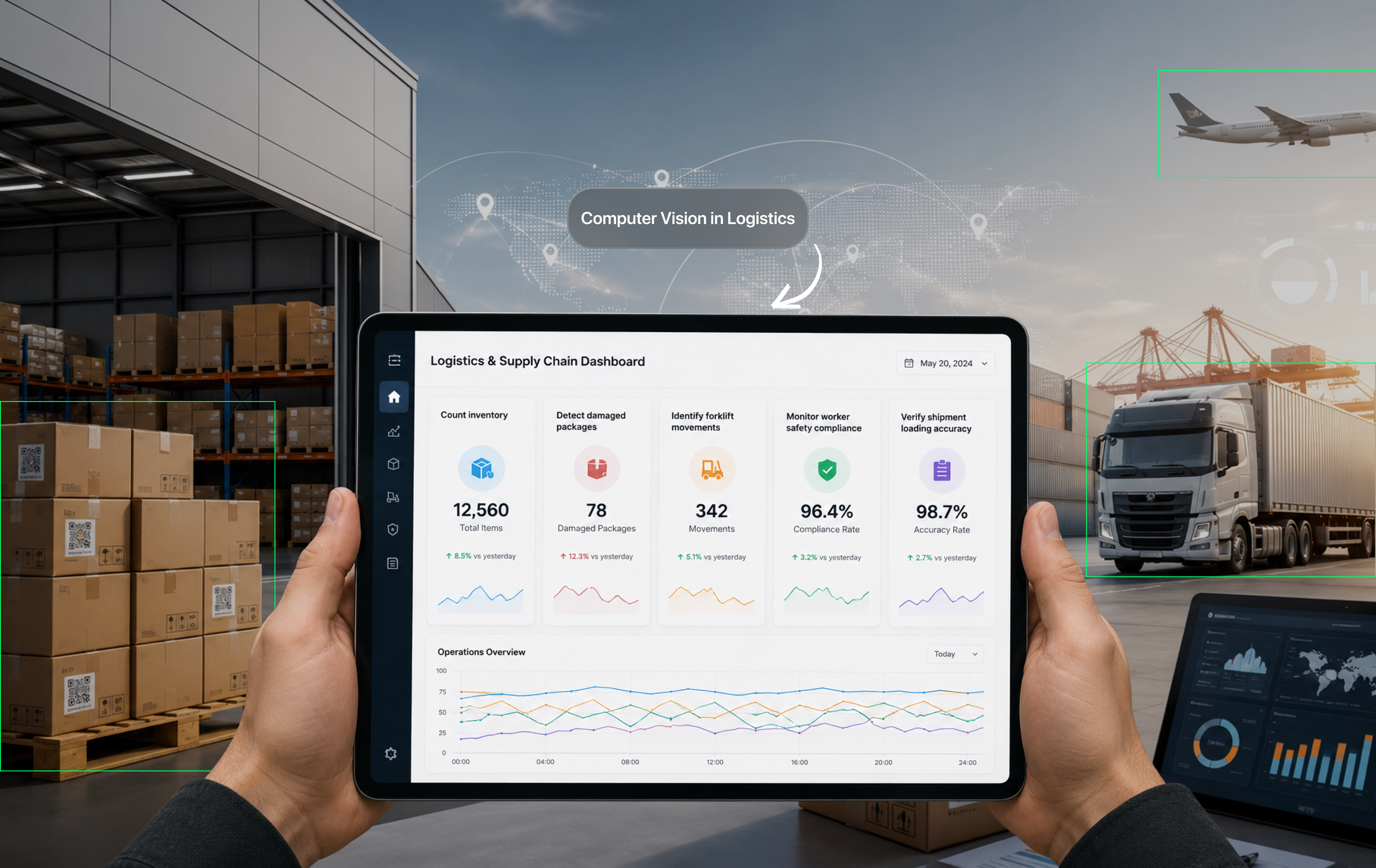
Modern logistics and supply chain operations are under more pressure than ever. Customers expect faster deliveries, warehouses are handling higher order volumes, and labor shortages continue to impact daily operations. At the same time, logistics companies must improve accuracy, safety, and efficiency without significantly increasing operational costs. These challenges are driving organizations to invest in AI-powered technologies that provide greater visibility and control across the supply chain.
One of the most impactful technologies leading this transformation is computer vision in logistics. Powered by artificial intelligence, computer vision systems use cameras and image-processing models to automatically identify products, track inventory, monitor assets, verify shipments, detect safety risks, and analyze warehouse activities in real time. Instead of relying solely on manual inspections, barcode scanning, and human observation, businesses can automate visual tasks and make faster, data-driven decisions.
As logistics networks become more complex, computer vision is evolving from an experimental technology into a core component of modern warehouse automation and supply chain visibility strategies. In this guide, you'll learn how computer vision works in logistics, the most valuable use cases in 2026, its benefits and implementation challenges, how to measure ROI, and real-world examples of leading logistics companies using visual AI to improve operational performance.
What Is Computer Vision in Logistics?
Computer vision in logistics refers to the use of artificial intelligence and image-processing technologies to analyze visual data from cameras, drones, scanners, and sensors. These systems automatically identify objects, monitor activities, detect anomalies, and support operational decision-making across warehouses, transportation networks, and supply chain operations.
Unlike traditional video surveillance, computer vision systems actively understand what they see.
For example, instead of merely recording warehouse activity, a computer vision system can:
Count inventory
Detect damaged packages
Identify forklift movements
Monitor worker safety compliance
Verify shipment loading accuracy
The result is greater operational visibility and reduced manual effort
Why Is Computer Vision Becoming Important for Logistics in 2026?
Computer vision is becoming a critical technology for logistics because modern supply chains generate more activity, data, and operational complexity than teams can effectively monitor manually. AI-powered visual intelligence systems help logistics companies improve visibility, enhance safety, reduce costly errors, and operate more efficiently without significantly increasing workforce requirements.
Several challenges are driving the adoption of computer vision across warehouses, distribution centers, transportation networks, and logistics yards.
Labor Shortages
Finding and retaining skilled warehouse and logistics workers remains a challenge. Computer vision helps automate repetitive visual tasks such as inventory checks, package verification, and facility monitoring, allowing employees to focus on higher-value activities.
Inventory Inaccuracies
Manual inventory tracking can lead to misplaced products, stock discrepancies, and fulfillment errors. Computer vision provides real-time inventory visibility by automatically identifying, counting, and tracking products throughout warehouse operations.
Warehouse Accidents and Safety Risks
Busy logistics facilities often involve forklifts, heavy equipment, and high worker activity. Computer vision systems continuously monitor operations, detect unsafe situations, and alert teams to potential hazards before accidents occur.
Delivery Disputes
Missing packages, incorrect deliveries, and customer claims can create operational challenges. Computer vision provides visual verification of deliveries, helping logistics companies maintain accountability and resolve disputes more efficiently.
Operational Inefficiencies
Many logistics processes still depend on manual inspections and supervision. Computer vision automates process monitoring, identifies bottlenecks, and provides actionable insights that improve overall operational performance.
Asset Losses and Tracking Challenges
Tracking trailers, containers, vehicles, and warehouse assets can be difficult across large logistics networks. Computer vision enables intelligent asset tracking, helping organizations reduce losses and maintain greater control over their operations.
Organizations are increasingly viewing computer vision as an operational intelligence layer rather than simply a security tool.
Why Businesses Are Investing in AI Development Services for Logistics
Computer vision is only one part of a broader artificial intelligence strategy. Many logistics companies are now partnering with AI development services providers to build intelligent systems that improve visibility, automate workflows, and support data-driven decision-making.
Modern AI development services can help logistics organizations:
- Build custom computer vision solutions
- Develop predictive analytics systems
- Automate warehouse operations
- Implement AI-powered quality inspection
- Deploy intelligent fleet monitoring
- Create supply chain optimization platforms
- Integrate AI with ERP, WMS, and TMS systems
Rather than deploying isolated tools, businesses increasingly seek end-to-end AI solutions that connect computer vision, machine learning, and operational analytics into a single ecosystem.
How Does Computer Vision Work in Logistics?
Computer vision systems use cameras, AI models, machine learning algorithms, and image-processing techniques to interpret visual data and identify patterns, objects, behaviors, or events in real time.
A typical workflow includes:
Step 1: Capture Visual Data
Data is collected from:
CCTV cameras
Mobile cameras
Drones
Vehicle-mounted cameras
Warehouse monitoring systems
Step 2: Process Images or Video
AI models analyze frames and extract relevant information.
Examples include:
Object recognition
Motion detection
Package identification
Vehicle tracking
Step 3: Detect Events
The system identifies predefined conditions such as:
Unsafe worker behavior
Inventory discrepancies
Unauthorized access
Damaged products
Step 4: Trigger Actions
The platform can:
Send alerts
Generate reports
Update inventory systems
Notify supervisors
This creates a closed-loop operational monitoring system.
What Are the Top Computer Vision Use Cases in Logistics?
1. Warehouse Inventory Management
Computer vision enables continuous inventory monitoring without requiring manual stock counting.
AI cameras can:
Count products automatically
Detect stock shortages
Identify misplaced items
Monitor shelf availability
This reduces cycle-counting efforts while improving inventory accuracy.
2. Automated Package Sorting
Sorting errors can create expensive delays.
Computer vision systems can:
Read labels
Recognize package dimensions
Verify destination information
Route packages automatically
Distribution centers processing thousands of parcels daily can significantly reduce sorting mistakes.
3. Fleet Monitoring and Vehicle Tracking
Transportation visibility remains one of the biggest logistics challenges.
Computer vision helps organizations:
Monitor fleet activity
Track vehicle arrivals
Detect route deviations
Analyze loading and unloading operations
This provides greater visibility across transportation networks.
4. Driver Safety Monitoring
Road safety directly impacts operational costs and compliance requirements.
Computer vision systems can identify:
Distracted driving
Fatigue indicators
Seatbelt violations
Mobile phone usage
Real-time alerts help prevent incidents before they occur.
5. Loading and Unloading Verification
Loading mistakes often create downstream delivery problems.
Computer vision verifies:
Correct shipment placement
Package counts
Loading sequence accuracy
Trailer utilization
This minimizes costly fulfillment errors.
6. Damage Detection and Quality Control
Computer vision can automatically detect visible damage to packages before products leave a warehouse.
Examples include:
Torn packaging
Crushed boxes
Missing labels
Product defects
Instead of relying solely on manual inspections, AI can continuously monitor quality standards.
7. Last-Mile Delivery Verification
Proof-of-delivery disputes consume time and resources.
Computer vision helps by:
Capturing delivery evidence
Verifying package placement
Recording delivery conditions
Supporting dispute resolution
This improves customer trust and accountability.
8. Smart Yard Management
Large logistics yards are difficult to manage manually.
Computer vision provides:
Vehicle tracking
Trailer identification
Gate automation
Congestion monitoring
Operations teams gain real-time awareness of yard activity.
9. Workplace Safety Compliance
Safety compliance remains a major priority across logistics facilities.
Computer vision systems can detect:
Missing helmets
Missing safety vests
Restricted-area access
Unsafe forklift interactions
The technology supports proactive safety management rather than reactive incident investigation.
10. Predictive Maintenance for Logistics Assets
Visual AI systems can monitor equipment conditions continuously.
Examples include:
Conveyor belts
Forklifts
Loading docks
Warehouse machinery
Early detection of wear patterns helps prevent unplanned downtime.
How Do Computer Vision Solutions Prevent Accidents in Logistics Yards?
Computer vision solutions improve yard safety by continuously monitoring vehicle movements, worker activity, restricted zones, and operational hazards. AI systems identify risks in real time and alert operators before accidents occur.
Common accident prevention in logistics applications includes:
Forklift-Pedestrian Detection
AI identifies when workers enter hazardous operating zones.
Blind Spot Monitoring
Cameras detect objects or personnel hidden from drivers.
Speed Monitoring
Computer vision tracks vehicle movement and identifies unsafe driving behavior.
Restricted Area Enforcement
The system automatically detects unauthorized access to dangerous locations.
These capabilities create safer working environments while supporting compliance requirements.
How Do Logistics Companies Use Computer Vision for Safety Compliance?
Computer vision helps logistics companies automate safety monitoring by continuously checking whether employees follow workplace procedures and equipment requirements.
Examples include:
Compliance Requirement | Computer Vision Function |
Helmet usage | PPE detection |
Safety vest compliance | Apparel recognition |
Hazard zone access | Area monitoring |
Vehicle safety checks | Automated inspection |
Loading procedures | Workflow validation |
Instead of conducting periodic audits, organizations gain continuous compliance visibility.
What Benefits Does Computer Vision Deliver to Logistics Operations?
Increased Operational Efficiency
Routine visual inspections become automated.
Employees spend less time monitoring and more time solving operational issues.
Improved Accuracy
AI systems consistently apply the same rules and standards.
This reduces human errors in inventory tracking and package handling.
Better Safety Performance
Real-time monitoring helps identify risks before incidents occur.
Enhanced Visibility
Leaders gain a live view of operations across warehouses, yards, and transportation networks.
Lower Operating Costs
Reducing manual inspections and operational errors can improve overall efficiency and resource utilization.
What Challenges Should Organizations Consider?
While computer vision offers significant benefits, successful implementation requires careful planning around infrastructure, data quality, integration, and workforce adoption.
Common challenges include:
Camera Infrastructure
Coverage gaps can limit system effectiveness.
Environmental Conditions
Poor lighting and weather conditions may impact performance.
System Integration
Computer vision platforms often need integration with:
WMS systems
ERP platforms
Transportation management software
Security systems
Workforce Adoption
Employees must understand that computer vision supports operations rather than replacing human expertise.
Successful deployments typically combine technology improvements with operational training.
A Practical Framework for Implementing Computer Vision in Logistics
Organizations considering adoption can follow this framework.
Phase 1: Identify High-Impact Use Cases
Focus on measurable operational challenges.
Examples:
Inventory inaccuracies
Safety incidents
Package damage
Phase 2: Evaluate Existing Infrastructure
Assess:
Camera coverage
Network capabilities
Storage requirements
Phase 3: Launch a Pilot Program
Start with one warehouse or operational area.
Measure outcomes before scaling.
Phase 4: Integrate Business Systems
Connect computer vision insights with operational workflows.
Phase 5: Scale Across Facilities
Expand deployment once performance and ROI are validated.
This phased approach reduces implementation risk while improving adoption success.
Real ROI Metrics: What Results Can Logistics Companies Expect?
While outcomes vary by operation size and deployment scope, organizations implementing computer vision typically focus on measurable operational improvements rather than technology adoption alone.
Common performance improvements reported across logistics and warehouse environments include:
KPI | Typical Improvement Range |
Inventory accuracy | 95% → 99%+ |
Manual inspection effort | 30–70% reduction |
Package sorting errors | 20–50% reduction |
Dock-to-stock processing time | 15–40% reduction |
Safety incident detection | Near real-time visibility |
Asset utilization | 10–25% improvement |
Delivery dispute resolution time | Significant reduction |
Research from McKinsey indicates that AI adoption across supply chain operations can reduce logistics costs by 5–20% while improving operational responsiveness and decision-making. Organizations increasingly view AI-powered visibility as a strategic advantage rather than simply an automation initiative.
Real-World Case Study: DHL Express Uses Computer Vision for International Shipping (2026)
Challenge:
One of the biggest challenges in international logistics is shipment classification and customs documentation. Customers often struggle to accurately describe products being shipped across borders, leading to incomplete customs declarations, shipment delays, manual reviews, and clearance issues. DHL identified that inaccurate shipment descriptions were creating friction in the shipping process and negatively impacting customer experience.
Computer Vision Implementation:
In May 2026, DHL Express launched an AI-powered item identification system powered by computer vision technology. Customers can simply take a photo of the item they want to ship using a smartphone. The computer vision model analyzes the image, identifies the product, and automatically generates a customs-compliant shipment description. The generated description can then be reviewed and submitted by the customer during the shipping process. DHL initially launched the solution across Canada, Germany, Hong Kong, the Netherlands, Singapore, South Africa, Spain, and the UAE.
Outcomes After Implementation:
The implementation helped DHL improve shipment data quality at the source by reducing manual data entry errors. According to DHL, the system delivers higher description accuracy, reduces customs-related delays, accelerates shipment clearance, and improves the overall customer experience. The initiative also became the first large-scale customer-facing computer vision deployment within the global express logistics industry.
Real-World Case Study: Lineage Logistics Uses AI and Computer Vision in Cold Chain Operations
Challenge:
Cold-storage warehouses operate in extremely low-temperature environments where manual inventory inspections can be slow, expensive, and potentially unsafe for employees. Maintaining accurate inventory visibility while minimizing worker exposure to freezing conditions has been a long-standing challenge for cold chain operators.
Computer Vision Implementation:
Lineage Logistics, one of the world's largest temperature-controlled logistics companies, has implemented AI-driven warehouse intelligence systems, including computer vision technologies, to monitor inventory movement, optimize product placement, improve warehouse workflows, and support automated storage decisions. Visual AI systems continuously track inventory and operational activity across cold-storage facilities.
Outcomes After Implementation:
The technology helped improve warehouse efficiency, increase inventory visibility, optimize storage and retrieval operations, and reduce worker exposure to sub-zero environments. AI-driven decision-making also enables more intelligent product placement based on demand patterns and inventory movement, supporting overall cold-chain efficiency.
What Is the Future of Computer Vision in Logistics?
The future of computer vision in logistics will involve deeper integration with AI, robotics, IoT devices, and predictive analytics systems.
Emerging developments include:
Autonomous warehouse operations
AI-powered robotics
Real-time digital twins
Drone-based inventory audits
Predictive supply chain intelligence
Edge AI processing
As AI models become more accurate and affordable, computer vision will move from isolated projects to core logistics infrastructure.
Expert Insights: What Industry Leaders Are Saying
Major logistics and consulting organizations consistently identify AI-driven visibility and automation as strategic priorities.
DHL Logistics Trend Radar
DHL identifies AI, computer vision, intelligent automation, and advanced analytics among the technologies expected to significantly influence logistics operations over the coming decade. The report highlights growing adoption across warehousing, transportation, and supply chain management.
McKinsey & Company
McKinsey notes that AI is evolving beyond isolated automation projects and increasingly supports end-to-end supply chain transformation, helping organizations improve decision-making, operational efficiency, and resilience.
IBM Institute for Business Value
IBM reports that organizations investing aggressively in AI-enabled supply chain capabilities achieve stronger financial performance and operational agility. When combined with vision systems and real-time data, AI can significantly improve visibility and responsiveness across supply chain networks.
Final Thoughts
The biggest advantage of computer vision in logistics is not automation alone. It is visibility.
When logistics teams can see what is happening across warehouses, yards, vehicles, and supply chain operations in real time, they make faster and better decisions. Safety improves. Errors decrease. Operational bottlenecks become easier to identify and fix.
If you're evaluating computer vision for logistics, start with one measurable problem. Build a focused pilot, validate results, and expand from there. The organizations seeing the strongest outcomes are not necessarily those deploying the most technology—they are the ones applying it to the right operational challenges.
 Ahmedabad, INDIA
 1214, Rashmi Prime, Besides STC Building, Vakil Saheb Bridge, Ambli, Ahmedabad, Gujarat – 380058
 USA
USA Dubai, UAE
 Singapore
 WhatsApp
 Gmail
Gmail Contact no


