



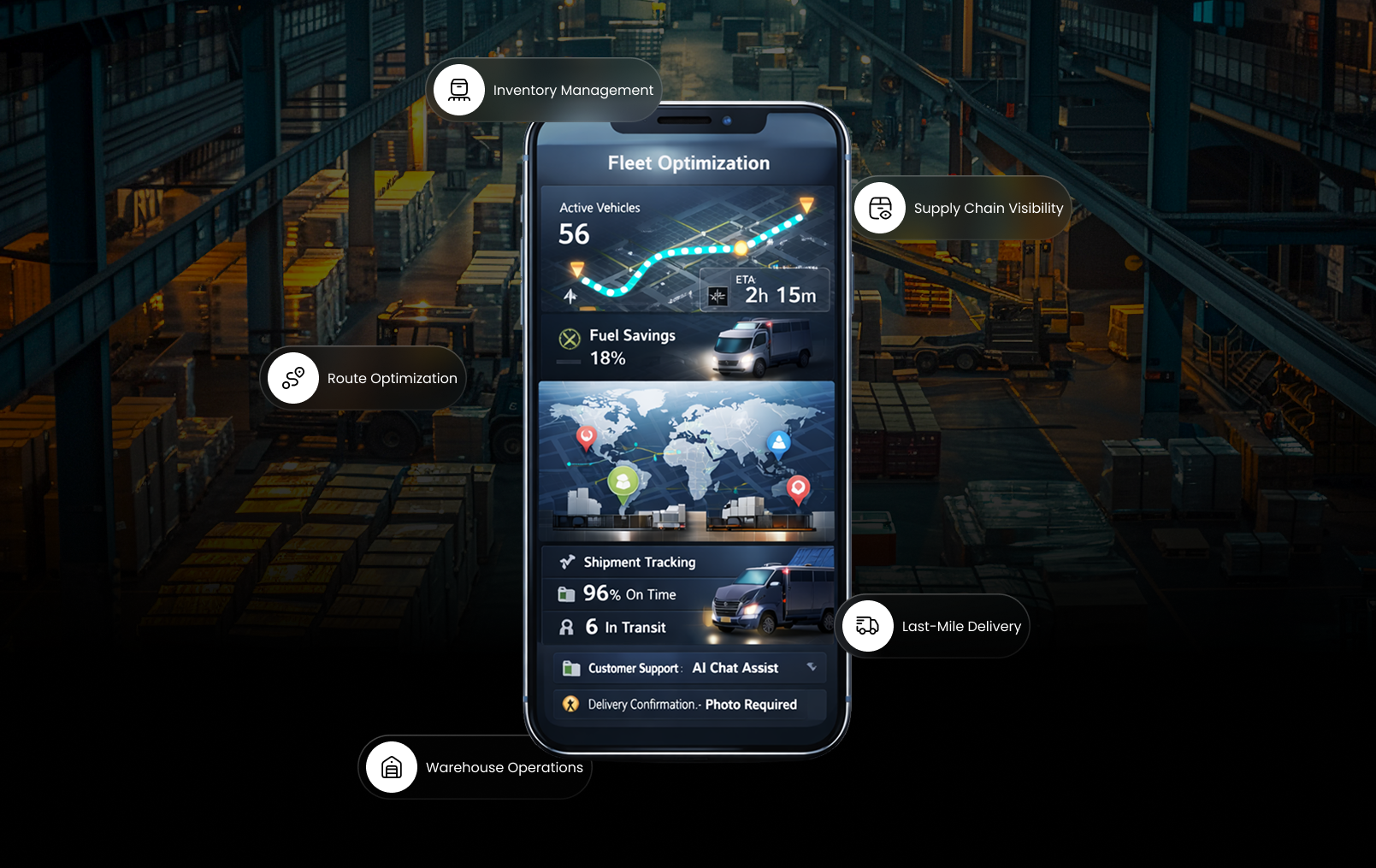
Supply chains used to be linear, predictable, and managed largely by spreadsheets and phone calls. That era is over. Today, a single disruption in a port halfway across the world can send shockwaves through retail shelves in New York within days. The complexity of modern logistics requires tools that are smarter, faster, and more adaptable than ever before. This is where the convergence of AI and Mobile Apps is creating a seismic shift.
Business leaders are no longer just looking for visibility; they want predictive power. They want to know a shipment is going to be late before the truck even hits the traffic jam. The integration of artificial intelligence into mobile platforms puts this power directly into the pockets of logistics managers, warehouse staff, and drivers.
This transformation isn't happening in a vacuum. It is being driven by the innovation of every app development company that recognizes the immense value of connecting data with physical movement.
In this Blog, we will explore the five most critical ways this technology duo is reshaping Supply Chain Management. From predictive analytics that foresee demand spikes to autonomous warehouse operations managed via smartphones, we will uncover how businesses are leveraging these tools to stay competitive in a volatile global market.
1. Real-Time Inventory Management and Demand Forecasting
The days of the quarterly inventory audit are numbered. One of the most significant pain points in Supply Chain Management has always been the lag between what is physically in the warehouse and what the digital records show.
The Power of Predictive AI
AI algorithms have moved beyond simple tracking. They now analyze vast historical data sets, seasonal trends, and even weather patterns to predict demand with startling accuracy. When this intelligence is delivered through a mobile interface, it transforms how floor managers operate.
Instead of reacting to a stockout, a warehouse manager receives a notification on their tablet suggesting a reorder because the AI predicts a surge in demand based on current market signals. This proactive approach reduces holding costs and prevents lost sales.
Mobile Scanning and Computer Vision
Modern inventory apps utilize the cameras on standard smartphones to perform complex tasks. An app development company can now build solutions where a worker simply points a phone at a shelf. Computer vision—a subset of AI—counts the stock instantly, identifies misplaced items, and updates the central database in real-time.
This eliminates the need for expensive, proprietary scanning hardware. It democratizes technology, allowing even smaller players in the supply chain to maintain 99% inventory accuracy. This seamless flow of data ensures that the entire chain, from manufacturer to retailer, operates on a single version of the truth.
2. Enhanced Fleet Management and Route Optimization
Transportation often accounts for the largest chunk of logistics costs. The integration of AI and Mobile Apps is aggressively attacking these costs by optimizing how goods move from point A to point B.
Dynamic Routing
Static routes are inefficient. Traffic accidents, road closures, and sudden weather changes can turn a profitable delivery run into a financial loss. AI-powered navigation apps do not just find the shortest path; they find the smartest one.
These systems analyze real-time traffic data and learn from past trips. If a specific delivery dock is notoriously slow on Tuesday mornings, the AI knows. It adjusts the schedule accordingly. Drivers receive these updates instantly on their mobile devices, allowing for mid-route corrections that save fuel and time.
Predictive Maintenance
A breakdown is more than an inconvenience; it is a disruption to the entire supply chain. AI algorithms can analyze data from sensors embedded in trucks—engine temperature, braking patterns, tire pressure—and predict mechanical failures before they happen.
This data is fed into a mobile dashboard for fleet managers. They can schedule maintenance during downtime rather than dealing with an emergency repair on the side of a highway. A mobile app development company in the USA that specializes in logistics can tailor these dashboards to alert drivers to specific driving behaviors that might be increasing wear and tear, fostering a culture of preventative care.
3. Autonomous Warehouse Operations
The warehouse of the future is not empty of people, but the people there are supercharged by technology. AI and Mobile Apps act as the central nervous system for robotic automation and human workflow.
The Cobot Revolution
Collaborative robots, or "cobots," work alongside humans to pick and pack orders. The coordination of these machines is often handled through sophisticated mobile interfaces. A floor supervisor can direct a fleet of autonomous mobile robots (AMRs) from an iPad, assigning them to high-volume aisles during peak hours.
AI optimizes the path of these robots to prevent congestion in the aisles. It also analyzes picking data to reorganize the warehouse layout dynamically. If a particular SKU is trending, the system recommends moving it closer to the packing station to shave seconds off every order.
Wearable Tech and Voice Picking
Mobile apps are extending into wearable technology. Smart glasses and wrist-mounted devices allow workers to receive picking instructions visually or through audio. This hands-free operation increases speed and reduces error rates.
The AI component validates every pick. If a worker grabs the wrong item, the system alerts them immediately. This real-time quality control prevents costly returns and ensures customer satisfaction. By partnering with a top-tier app development company, logistics firms are creating custom interfaces that reduce training time for new employees from weeks to days.
4. End-to-End Supply Chain Visibility
Perhaps the "Holy Grail" of Supply Chain Management is total visibility. Stakeholders want to see the status of raw materials, manufacturing progress, and final delivery all in one place.
Breaking Down Silos
Traditionally, shipping data, manufacturing data, and sales data lived in separate silos. AI acts as the bridge. It ingests unstructured data from emails, invoices, and IoT sensors to create a unified view of the supply network.
Mobile apps serve as the window into this complex data structure. A logistics director traveling for business can pull up an app and see exactly where a critical shipment of components is stuck in customs.
Blockchain and AI Integration
To ensure trust and transparency, many companies are combining AI with blockchain technology, accessible via mobile dApps (decentralized apps). Every handoff in the supply chain is recorded immutably.
AI scans these records for anomalies. If a shipment of temperature-sensitive pharmaceuticals creates a data log showing a temperature spike, the AI flags it instantly. The recipient is notified via their mobile app before the goods even arrive, allowing for immediate remediation. A mobile app development company in USA is uniquely positioned to build these high-security, compliant interfaces given the strict regulatory environment of North American logistics.
5. Intelligent Customer Service and Last-Mile Delivery
The final leg of the journey—the last mile—is often the most expensive and the most critical for customer satisfaction. AI and Mobile Apps are redefining how businesses interact with the end customer.
AI Chatbots and Support
Customers expect instant answers. AI-driven chatbots integrated into mobile apps handle thousands of inquiries simultaneously. "Where is my order?" "Can I change the delivery address?" These routine questions are answered instantly, 24/7, without human intervention.
When a complex issue arises, the AI seamlessly hands the conversation over to a human agent, providing them with the full context. This hybrid approach ensures efficiency without sacrificing the personal touch.
The Uberization of Freight
The gig economy model has entered logistics. Mobile platforms connect shippers directly with freelance drivers for local deliveries. AI matches the load with the right vehicle and the right driver based on location, capacity, and rating.
This flexibility allows businesses to scale their delivery capacity up or down instantly. During the holiday rush, a retailer can tap into a network of on-demand drivers through a mobile app to ensure on-time delivery. It creates an elastic supply chain capable of absorbing demand shocks.
The Role of Development Partners
Implementing these technologies is not a plug-and-play affair. It requires a strategic partnership with a capable app development company. Off-the-shelf software rarely fits the unique complexities of a global supply chain. Custom solutions are often required to integrate legacy systems with modern AI tools.
For American enterprises, working with a mobile app development company in the USA offers distinct advantages. Proximity allows for better collaboration, and a deep understanding of the local logistics infrastructure—from the ports of Long Beach to the trucking routes of the Midwest—is invaluable. These developers understand the specific compliance requirements and data security standards necessary to protect sensitive trade secrets.
Conclusion
The convergence of AI and Mobile Apps is not just an incremental improvement; it is a fundamental rewriting of the rules of logistics. By moving from reactive to proactive, and from manual to automated, businesses can wring inefficiencies out of their operations that they didn't even know existed.
For leaders in Supply Chain Management, the message is clear: digitization is no longer optional. The companies that successfully integrate these technologies will be faster, leaner, and more resilient. Those who do not risk being left behind in a slow lane that no longer exists.
Whether it is through real-time inventory tracking, predictive fleet maintenance, or autonomous warehousing, the tools are available. The next step is to connect with Icode49 Technolabs technology partner, to build the bridge between your current operations and the future of logistics.
 Ahmedabad, INDIA
 1214, Rashmi Prime, Besides STC Building, Vakil Saheb Bridge, Ambli, Ahmedabad, Gujarat – 380058
 USA
USA Dubai, UAE
 Singapore
 WhatsApp
 Gmail
Gmail Contact no


