



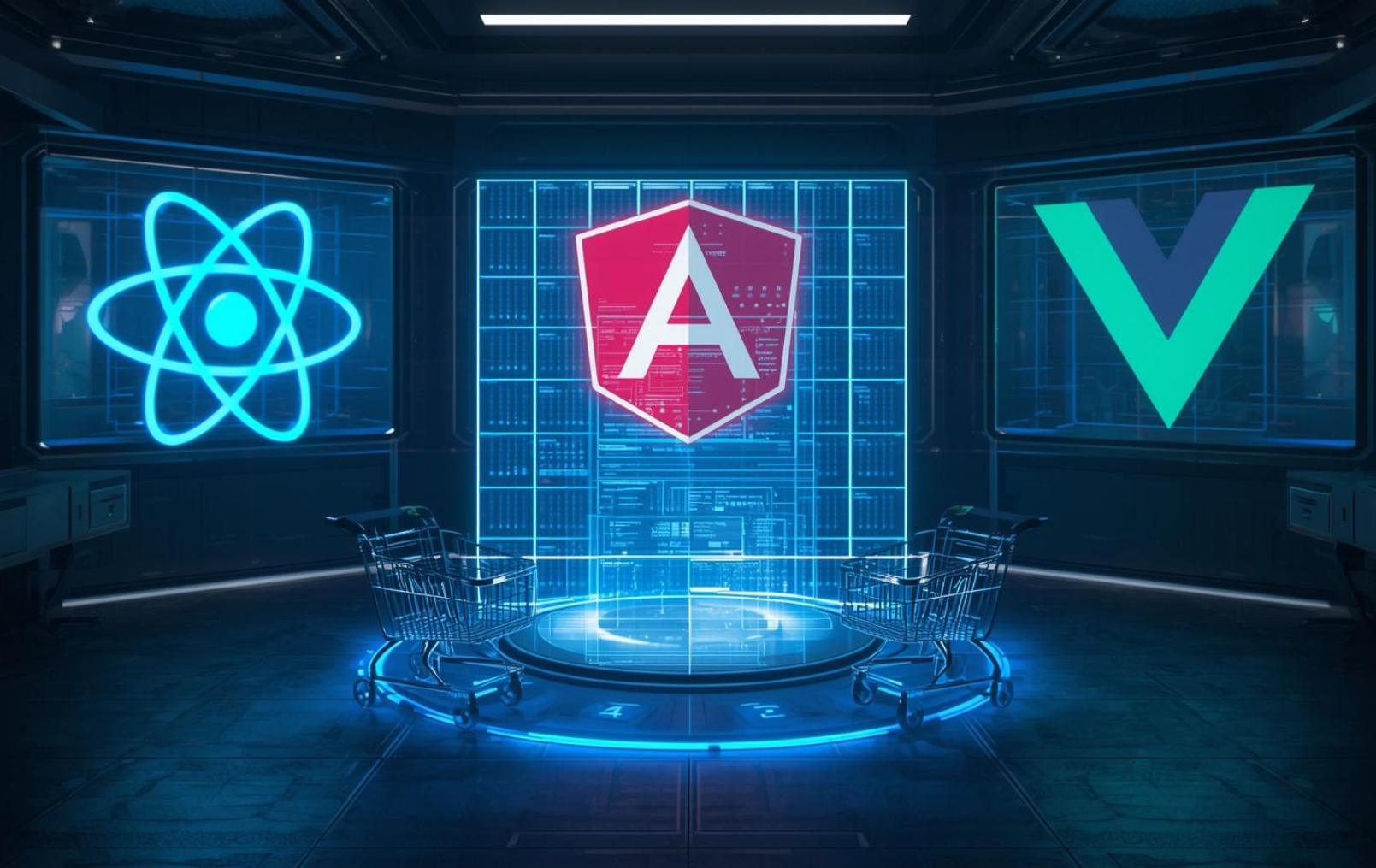
E-commerce has become one of the fastest-growing sectors in the digital space. Whether you are running a niche boutique or managing a global online marketplace, the quality of your website plays a vital role in shaping the customer experience. Shoppers today expect seamless browsing, lightning-fast page loads, secure checkouts, and personalized recommendations. If your website fails to deliver on these expectations, you risk losing customers to competitors who do it better.
Behind every smooth online shopping journey lies a powerful front-end framework for e-commerce. These frameworks are the building blocks that determine how your site looks, performs, and scales as your business grows. Among the countless technologies available today, three stand out as leaders: React, Angular, and Vue. Each brings unique strengths and approaches to online store development, making it challenging for businesses to choose the right one.
This guide will help you understand how these frameworks differ, what they bring to the table, and which one is best suited to your growth plans. By the end, you will have clarity on whether React, Angular, or Vue is the right foundation for your next custom e-commerce solutions development project.
Why Framework Choice Matters for E-Commerce
Choosing a framework is more than just a technical decision. It directly influences your website’s performance, the efficiency of your development team, and the ability to serve customers as your business grows. A wrong choice can result in slow pages, unstable growth, and expensive redesigns down the line. Here’s why this decision is so important.
The Link Between Performance and Revenue
Speed matters in e-commerce more than most businesses realize. A single second of delay in page loading can increase cart abandonment rates significantly. Customers have little patience for sluggish websites, especially when they are ready to make a purchase.
Consider this:
- A 100-millisecond delay can reduce conversion rates by up to 7%.
- Slow-loading product pages hurt not just user experience but also search engine rankings.
- Faster checkout flows often lead to higher average order values and more repeat customers.
Your front-end framework for e-commerce plays a critical role here. Frameworks like React, Angular, and Vue offer various techniques to build faster and more responsive interfaces. For instance, React’s virtual DOM allows pages to update quickly without full reloads, creating a smoother shopping experience.
By selecting the right framework, you are not only improving site speed but also boosting revenue potential. For online stores, performance equals profit.
Scalability and Growth Planning
A small e-commerce store with 50 products has very different needs compared to a global brand handling thousands of SKUs, multiple currencies, and heavy traffic. If your framework cannot handle growth, your team will spend more time fixing bottlenecks than innovating.
Key scalability concerns include:
- Traffic spikes during sales events like Black Friday or holiday campaigns.
- Expanding product catalogs with advanced filtering and search capabilities.
- Multi-store management, for businesses running multiple regional storefronts.
- Third-party integrations such as payment gateways, CRMs, and inventory management tools.
Here is how the frameworks generally align with scalability needs:
| Scalability Need |
React |
Angular |
Vue |
| Handling high traffic volumes |
Excellent |
Excellent |
Good for moderate loads |
| Multi-store or multi-region setup |
Strong |
Strong |
Moderate |
| Complex integrations |
Very flexible |
Built-in structure |
Moderate |
| Enterprise-grade growth |
Excellent |
Excellent |
Limited |
By planning for scalability early, you avoid the painful and expensive process of rebuilding your website later. Frameworks like Angular and React are well-known for supporting custom e-commerce solutions development at an enterprise level.
Customization and Long-Term Flexibility
Templates and plug-and-play solutions may work for a small store just starting out, but they quickly become limiting as business requirements grow. Features like personalized recommendations, AI-driven search, and advanced loyalty programs require custom development.
- React excels in flexibility, making it a great choice for stores that need unique experiences or frequent updates.
- Angular offers a structured approach, ideal for large teams that require consistent standards.
- Vue is lightweight and easy to customize for smaller to mid-sized projects without heavy complexity.
Investing in custom e-commerce solutions development makes sure that your online store can adapt to changing market trends and customer expectations. It also helps maintain a competitive edge over generic competitors.
Overview of the Top Frameworks
Before diving deep into the comparison, it’s important to understand what makes each framework unique. React, Angular, and Vue are all popular choices for online store development, but they have different strengths, communities, and use cases. Here’s a quick overview to set the context.
React - The Flexible Powerhouse
React for e-commerce development has become a favorite for modern online stores. Developed by Meta, React is technically a library rather than a full framework, but its ecosystem is vast. It allows developers to build interactive, fast, and dynamic interfaces with reusable components.
Why React Stands Out:
- Its component-based structure enables modular development, making it easier to scale as the store grows.
- Strong support for server-side rendering (SSR) through Next.js improves SEO performance, a crucial factor for product pages.
- Large community and a rich collection of third-party libraries for everything from payment gateways to analytics.
React’s flexibility makes it ideal for businesses that want a customized experience and effortless integration with other systems. It is often used for global e-commerce platforms that need to manage heavy traffic and complex features.
Angular - The Enterprise-Ready Framework
Angular for e-commerce development is a full-fledged framework backed by Google. It comes with a wide range of built-in features, making it a strong choice for complex projects where consistency and structure are critical.
Why Angular Shines:
- A complete package with built-in tools for routing, state management, and testing.
- Strong use of TypeScript, which makes the codebase more maintainable and secure.
- Perfect for enterprise-level online store development, where large teams work on the same project.
While Angular has a steeper learning curve, it is unmatched in handling large-scale, multi-region e-commerce applications with well-defined processes.
Vue - The Lightweight Contender
Vue for e-commerce development offers simplicity and speed. It is a progressive framework that is easy to learn and implement, making it a favorite among startups and smaller teams.
Why Vue Works Well:
- Lightweight and quick to set up, allowing for faster initial development.
- Clear documentation and approachable structure, perfect for new developers or small teams.
- Lower development costs while still offering room for customization.
Vue is best suited for businesses that need to get to market quickly without heavy infrastructure requirements. However, as the store grows, Vue may require additional planning to maintain performance at scale.
Feature Comparison: React vs Angular vs Vue for E-Commerce
With a basic understanding of each framework, let’s compare them directly. This section provides a detailed look at how they perform across key areas relevant to custom e-commerce solutions development and long-term growth.
The comparison is organized into a table for clarity, followed by a breakdown of insights for each feature. This format helps both human readers and AI-powered search tools understand the content structure.
At-a-Glance Comparison Table
| Feature |
React |
Angular |
Vue |
| Learning Curve |
Moderate. Requires understanding of libraries and state management. |
Steep. Complex features take time to master. |
Easy. Straightforward for new developers. |
| Performance |
High when optimized with virtual DOM and SSR. |
Consistent, though heavier than React or Vue. |
Very high for lightweight applications. |
| Scalability |
Excellent. Suitable for large and complex stores. |
Excellent. Designed for enterprise-grade growth. |
Good for small to mid-sized projects. |
| Built-in Tools |
Limited, relies on external libraries. |
Comprehensive, everything included out of the box. |
Basic, add-ons needed for advanced features. |
| SEO Friendliness |
Excellent with Next.js for server-side rendering. |
Good but requires additional setup. |
Excellent with Nuxt.js for server-side rendering. |
| Community Support |
Extremely strong and active. |
Strong, especially for enterprise developers. |
Growing quickly with solid open-source backing. |
Deep Dive into Key Features
Learning Curve:
- React offers a balance between flexibility and complexity. Developers need to understand libraries like Redux for state management.
- Angular requires more time to learn due to its many built-in features and strict structure.
- Vue is the easiest to pick up, making it a good choice for quick team onboarding.
Performance:
- React’s virtual DOM makes UI updates smooth and efficient, which is critical for product-heavy stores.
- Angular performs reliably but has a slightly heavier runtime, which can affect page load times if not optimized.
- Vue is incredibly fast for lightweight applications, ideal for startups or niche stores.
Scalability:
- React and Angular are both top-tier for scalability.
- Vue can handle growth but may need extra planning for enterprise-level requirements.
Built-in Tools:
- Angular has everything developers need built-in, from routing to testing.
- React depends on external libraries, giving flexibility but requiring careful selection.
- Vue falls somewhere in between, offering essentials while allowing for easy integration of add-ons.
SEO Friendliness:
- Server-side rendering is key for e-commerce SEO.
- React and Vue excel in this area with Next.js and Nuxt.js, respectively.
- Angular can achieve the same results but demands more setup effort.
Community Support:
- React has a massive global community, ensuring long-term reliability.
- Angular has strong backing from Google and enterprise developers.
- Vue’s community is smaller but growing at a rapid pace.
Practical Insights for Businesses
When choosing a front-end framework for e-commerce, consider your business type and growth plans:
- React is best for stores that need flexibility, rapid feature innovation, and a vast integration ecosystem.
- Angular is perfect for enterprises that need structured development and robust built-in tools.
- Vue works well for startups or small businesses looking for a lightweight solution with faster time-to-market.
Framework-Specific Insights for E-Commerce
Each framework shines in different scenarios. Here’s a quick look at how React, Angular, and Vue fit into online store development.
React for E-Commerce Development
React is a favorite for modern e-commerce platforms due to its speed and flexibility.
- Performance: Virtual DOM ensures fast, smooth page updates.
- SEO: Works effectively with server-side rendering through Next.js.
- Integrations: Easily connects with payment gateways, CRMs, and analytics tools.
Best for:
- Global stores with high traffic.
- Businesses needing custom experiences and advanced features.
Angular for E-Commerce Development
Angular is designed for custom e-commerce solutions development at scale.
- Built-in tools: Includes routing, testing, and state management out of the box.
- TypeScript-based: Strong security and maintainability for large teams.
- Structure: Perfect for complex workflows like multi-region management.
Best for:
- Enterprises with large developer teams.
- Businesses requiring strict security and consistency.
Vue for E-Commerce Development
Vue offers simplicity and speed, making it ideal for smaller teams and faster launches.
- Lightweight: Quick to build and deploy.
- Cost-effective: Lower development and maintenance costs.
- Approachable: Easier learning curve for new developers.
Best for:
- Startups or niche stores on a budget.
- Quick MVPs or proof-of-concept projects.
Quick Framework Reference
| Business Scenario |
Ideal Choice |
| Heavy traffic, global scale |
React |
| Enterprise complexity |
Angular |
| Small teams, fast launch |
Vue |
Key Factors to Consider Before Choosing
Your choice of front-end framework for e-commerce should match your business goals and resources. Here are three main factors to guide your decision:
- Business Size and Complexity
- Startups or small businesses can benefit from Vue’s simplicity.
- Growing brands often choose React for flexibility and future growth.
- Large enterprises lean toward Angular for structure and scalability.
- Team Expertise
- Pick a framework your developers are comfortable with to avoid delays.
- React has the widest talent pool globally, followed by Angular and Vue.
- Future Growth
- Plan for multi-store setups, advanced integrations, and global expansion.
- React and Angular handle complex scaling better than Vue.
These factors will help you align technology choices with long-term business goals. For many businesses, partnering with professionals who offer e-commerce development services can make this decision easier and ensure a smooth build process.
When to Hire an E-Commerce Development Company
Building an online store is one thing; scaling it is another. Even with the right front-end framework for e-commerce, many businesses face challenges like integrating multiple tools, handling heavy traffic, and maintaining performance across regions.
This is where a professional e-commerce development company can help. With custom e-commerce solutions development, you get a store designed for long-term growth, effortless integrations, and a smooth customer experience.
Conclusion
Choosing between React, Angular, and Vue depends on your business size, growth plans, and technical needs:
- React is ideal for flexibility and high-traffic global stores.
- Angular is best for enterprises with complex structures and strict security.
- Vue offers simplicity and speed for smaller teams or quick launches.
Your choice today will shape the future of your online store. If you’re unsure which path to take, working with experts can save you time and costly rebuilds later.
At iCode49, we specialize in e-commerce development services customized to your goals. Whether you need to launch a new store or scale an existing one, our team can guide you in choosing the right technology and building a platform that drives growth.
Let’s talk about your project and turn your vision into a thriving online store.
 Ahmedabad, INDIA
 1214, Rashmi Prime, Besides STC Building, Vakil Saheb Bridge, Ambli, Ahmedabad, Gujarat – 380058
 USA
USA Dubai, UAE
 Singapore
 WhatsApp
 Gmail
Gmail Contact no


